



18 Best Prop Trading Firms You Can Trust in 2026
Discover the 18 Best Prop Trading Firms in 2026, trusted by traders for reliability, funding options, and expert support.

You spot recurring Trading Patterns on your screen, but lack the capital or structure to turn them into steady income. Picking the right prop trading firm matters as much as your edge; the wrong firm can stall progress with hidden fees, rigid rules, or a long evaluation.
Which provider lets you get funded fast, keep a fair profit split, and scale with simple risk rules? This guide cuts through firm claims and shows how to pick a trusted property firm quickly, get instantly funded with real capital, and scale profits with simple rules.
If that sounds like the fast path you want, Aquafutures offers funded accounts for futures trading that move you from evaluation to real capital with clear rules, transparent payouts, and practical risk management so you can grow your capital allocation and scale profits.
Summary
- Prop firms enforce layered risk controls because they can leverage up to 10 times their capital, so per-trade limits, daily loss floors, and automated kill-switches are essential to prevent a single mistake from wiping out firm capital.
- Fast, repeatable edges attract the bulk of capital, with over 70% of prop trading firms using high-frequency strategies, which means discretionary intraday signals must coexist with automation that chases latency and microstructure advantages.
- Risk creep after funding, not analysis, is the common failure mode, and 95% of successful traders cite risk management as a key factor, underscoring why staged scaling and strict loss controls matter more than chasing one big score.
- Execution quality and access to tooling determine whether an edge becomes cash, with 70% of successful traders crediting proprietary trading tools as decisive, so tick data, slippage reports, and order replay are non-negotiable operational proofs.
- Regulatory status shifts where risk sits: roughly 70% of proprietary trading firms operate without direct oversight, while about 30% are registered, trading formal legal recourse for faster onboarding and product agility.
- Payout certainty, support responsiveness, and cost clarity change trader behavior, with firms offering 24/7 support showing a 30% higher trader satisfaction rate and over 70% of traders naming cost transparency as crucial when choosing a provider.
- This is where Aquafutures' funded accounts for futures trading fit in, by providing instant funded access, transparent simulated-capital rules, and rapid payout SLAs so traders can compress iteration time while preserving staged risk controls.
What are Prop Trading Firms, and How Do They Work?

Prop trading firms are businesses that deploy firm capital through structured trader programs and algorithmic strategies, capturing an edge by combining risk controls, technology, and trader incentives. They operate as both talent platforms and active market participants. You should think of them as focused risk engines, where capital allocation, turnover, and strict loss limits determine whether a strategy scales or gets shut down.
How do firms size positions and enforce risk?
Capital is allocated in tiers, not as a single blind check. Firms layer limits: per-trade size, daily loss floors, and time-based scaling rules, so a new trader cannot suddenly double exposure. That approach matters because, according to Prop trading firms, they can leverage up to 10 times their capital.
HighStrike Trading, the capacity to magnify exposure, requires rigorous position controls and automated kill switches to prevent a single mistake from wiping out large chunks of firm capital. In practice, this means traders hit hard ceilings early, then earn increments of buying power as they prove repeatable performance, keeping both the firm solvent and the trader accountable.
What strategies actually dominate, and why should you care?
Strategy mix drives everything from tech spend to PnL cadence. Most capital gets funneled into fast, repeatable edges, not long-shot bets, because speed and execution certainty win at scale. That’s reflected in the industry's tilt toward automation: over 70% of prop trading firms use high-frequency trading strategies. HighStrike Trading, which explains why the best prop trading firms invest heavily in co-location, market data feeds, and real-time attribution systems. For a discretionary trader, that means your short-term signals must coexist with automated strategies that chase spread, latency, and microstructure edges.
How do traders move from evaluation to real capital without collapsing?
This is where human psychology and process meet. The familiar path is an evaluation, then funding, then a rookie sprint to prove returns. That pattern appears across funded programs: discipline during evaluation often gives way to looser sizing after funding, and the failure point is almost always risk creep, not bad analysis. When discipline slips, firms respond with staged scaling, mandatory cool-downs after drawdowns, and automatic leverage reductions. Those operational rules protect both parties and explain why consistent, small wins matter more than one big score.
Why do infrastructure and ops matter as much as strategy?
Execution quality, margin routing, and compliance determine whether a strategy’s theoretical edge actually becomes cash. Firms build tight feedback loops: live fills feed PnL engines, slippage models update risk limits, and audit trails backtest any trader action against policy. That emphasis on ops is why you’ll see heavy spending on order management systems, connectivity, and compliance workflows at firms aiming to be among the best prop trading firms. Poor plumbing turns an otherwise viable method into a losing one within weeks.
Most teams fund the familiar way, with lengthy, manual vetting that preserves quality but drains momentum. As firms scale, that delay buries traders’ best setups and incentivizes shortcuts. Platforms like AquaFutures provide an alternative path, offering instant funded accounts with transparent simulated-capital rules, faster payouts, and clear reward structures that compress time-to-live while preserving staged risk controls.
It’s exhausting when a trader finally gets funded, and instinct overrides discipline, because the celebration that follows can feel like the moment everything will change — until the account numbers tell a different story.
But the real reason this keeps happening goes deeper than most people realize.
Related Reading
- What Is a Funded Trading Account
- What Is SMT in Trading
- Price Action Trading
- Intraday Trading Tips for Today
- Can Day Trading Be Profitable
- Trading Indicators
- Forex Trading Candlestick Patterns
- Intraday Algorithmic Trading
- Trading Candlestick Patterns
- Volatility Trading
What Makes a Prop Trading Firm Good?

A good prop trading firm earns your trust the moment you can verify its promises, not when its marketing sounds plausible. Look for consistent, on-time payouts, clear rulebooks you can read in under 20 minutes, and tools that let you trade without guessing how the platform will behave.
How do you judge credibility beyond marketing?
Reputation is not a logo; it is evidence. Watch withdrawal records, not testimonials; ask whether rules are enforced consistently or selectively; and scan for audit trails on fills and trade history.
This pattern appears across both evaluation programs and funded accounts: payout friction and opaque rules erode trader trust and produce chronic anxiety, because the damage is emotional as much as financial. When traders hit payout snags, they stop optimizing their strategy and start managing paperwork, and that shift kills momentum.
What does real customer support look like for traders?
Support means rapid, expert help during critical moments, not canned replies the next business day. According to FunderPro Blog, firms with a 24/7 support system have a 30% higher trader satisfaction rate, so responsiveness is measurable, not optional. Practically, that means instant chat or phone escalation for execution, a dedicated claims pipeline for disputed fills, and visible SLAs for payout requests. Traders tell us the relief of a single reliable contact can change a week of stress into an afternoon fix; that human reliability often outweighs a marginally better profit split.
How much does access to proprietary tools affect outcomes?
Access to purpose-built execution and analytics shapes consistent performance, because strategy without reproducible tooling is fragile, according to the FunderPro Blog. 70% of successful traders cite access to proprietary trading tools as a key factor, underscoring that platform capabilities often distinguish repeatable winners from short-term lucky streaks. Look for firms that provide clean tick data, slippage reporting, and order replay; those features turn hypotheses into testable experiments. Without them, success stories are anecdotes, not a system.
Why do education and mentorship actually matter in practice?
Education that combines live coaching, trade reviews, and accountability transforms behavior. This shows up in two ways: traders who receive weekly trade reviews adjust position sizing sooner, reducing the severity of losing runs, and they reapply those rules as the account scales. The failure mode I see repeatedly is one-off webinars that feel motivational but leave traders without a follow-up plan; structured feedback, even 30 minutes weekly for three months, produces measurable behavior change.
Status quo friction, the hidden cost, and a practical bridge
Most traders validate strategies through slow, bureaucratic funding processes because they feel rigorous and familiar. That approach works early, but as you try to iterate and scale, review cycles and payout lag fragment momentum, turning live edge capture into a scheduling problem. Platforms like AquaFutures provide instant funded accounts with transparent simulated-capital rules and rapid payouts, compressing iteration time while keeping staged risk controls and documentation intact, so traders can test and monetize quickly without losing auditability.
What clear red flags should make you pause?
- Hidden fee clauses are buried in lengthy PDFs, especially withdrawal or inactivity charges.
- No public history of timely payouts or inconsistent enforcement of rules.
- Support is routed exclusively via email, with multi-day SLAs and no real-time escalation.
- Education that is generic, one-off, or lacks trade-level feedback.
If you find two or more of these, your friction cost will likely outweigh any advertised profit split.
Think of a high-quality firm like a well-tuned instrument: calibration, reliable parts, and an honest tuner matter more than a flashy finish.
That question nagging at the back of your mind about who really watches the watchers is not going away.
Are Proprietary Trading Firms Regulated?

Proprietary trading firms sit on a spectrum: some are subject to formal oversight, while many operate without direct regulatory registration, and that difference affects the practical protections a trader can expect. Whether a firm is regulated depends on its legal structure and activities, and this choice matters for dispute resolution, auditability, and loss handling.
How common is it for firms to be unregulated?
A surprisingly large share of firms operate outside direct oversight, with Investing.com (2023) reporting that approximately 70% of proprietary trading firms are not directly regulated by central financial authorities, which means most traders will encounter providers that answer to commercial contracts rather than federal examiners. In plain terms, most of the market relies on private rules and platform terms rather than standardized, regulator-enforced protections.
If only a minority is registered, what does that mean day to day?
Financial Tech Times (2025) reports that only 30% of proprietary trading firms are registered with financial regulators, indicating that registration remains the exception rather than the norm in industry practice. Practically, that affects speed and redress: registered firms typically publish audited controls and submit to exams, while unregistered firms prioritize operational flexibility, faster product changes, and often quicker onboarding and payouts, at the cost of formal oversight.
Which behaviors draw regulatory attention now?
This pattern appears consistently across onshore and offshore firms, firms that blur market making and trading, those that rely heavily on venue rebates, or those structuring products that look like pooled customer money, and those are the ones that attract scrutiny. When a prop desk starts acting like a broker or dealer, regulators step in and demand registration, audits, and capital rules. That shift can force sudden operational changes, which is why clarity about a firm’s revenue model matters as much as its legal label.
Status quo friction and a practical alternative
Most traders pick firms by reputation or immediate convenience because that feels faster and less academic, and that makes sense when you need to keep testing the edge. But the hidden cost is real: chasing a name or speed can bury you in contract disputes and payout delays that eat strategy time and confidence.
Platforms like AquaFutures' instant-funded accounts for futures trading offer a different trade-off: fast access, transparent simulated-capital rules, and defined payout SLAs, while avoiding the legal baggage of handling client funds, so traders can iterate quickly without sacrificing clarity.
What should you check beyond registration?
Registration is a helpful signal, but not the whole checklist. Ask for written payout SLAs, recent payout timestamps, published execution logs or slippage reports, and an explicit arbitration clause that names jurisdiction and a timeline, because those items determine how quickly a problem gets resolved. Try a small live cycle, collect time-stamped withdrawal evidence, and evaluate responsiveness to claims before scaling exposure; these behavioral checks reveal operational reliability faster than a logo on a page.
How regulation, or the lack of it, changes your risk profile
Think of regulatory status as a change in where risk sits, not whether risk exists. With registered firms, some legal levers and standardized audits reduce certain tail risks, but they can also slow product evolution. With unregistered firms, you trade legal recourse for agility and, at times, better economics. The practical question is whether you value formalized recourse and transparency more, or speed, generous trader splits, and rapid iteration. That tradeoff is personal and strategic, and it should drive how you test and scale with any prop provider.
I still see traders lose months to paperwork when a single payout stalls, and that avoidable friction is precisely why thoughtful checks matter now more than ever.
That choice between formal safety and fast, trader-first access is becoming sharper, and what happens next will determine which firms traders can trust.
18 Best Prop Trading Firms You Can Trust in 2026
Identifying trustworthy prop trading firms requires verifying payouts, assessing business longevity, and evaluating consistent trader feedback. Top firms in 2026 share key traits: clear rules, fast withdrawals, helpful support, and business models that support trader success.
These platforms cover futures to forex trading, focusing on reliability over marketing. Key differences emerge in specific details: guaranteed payout times, published profit split details, and quick support response.
The proprietary trading industry continues growing, offering funded accounts with substantial capital, high profit splits (80-100%), and flexible rules across multiple markets. Trusted firms distinguish themselves through verified payouts, transparent evaluations, rapid withdrawals, and strong scaling potential.
Top options balance quick access, clear risk guidelines, and aggressive growth potential while minimizing hidden restrictions and payout complications.
1. AquaFutures
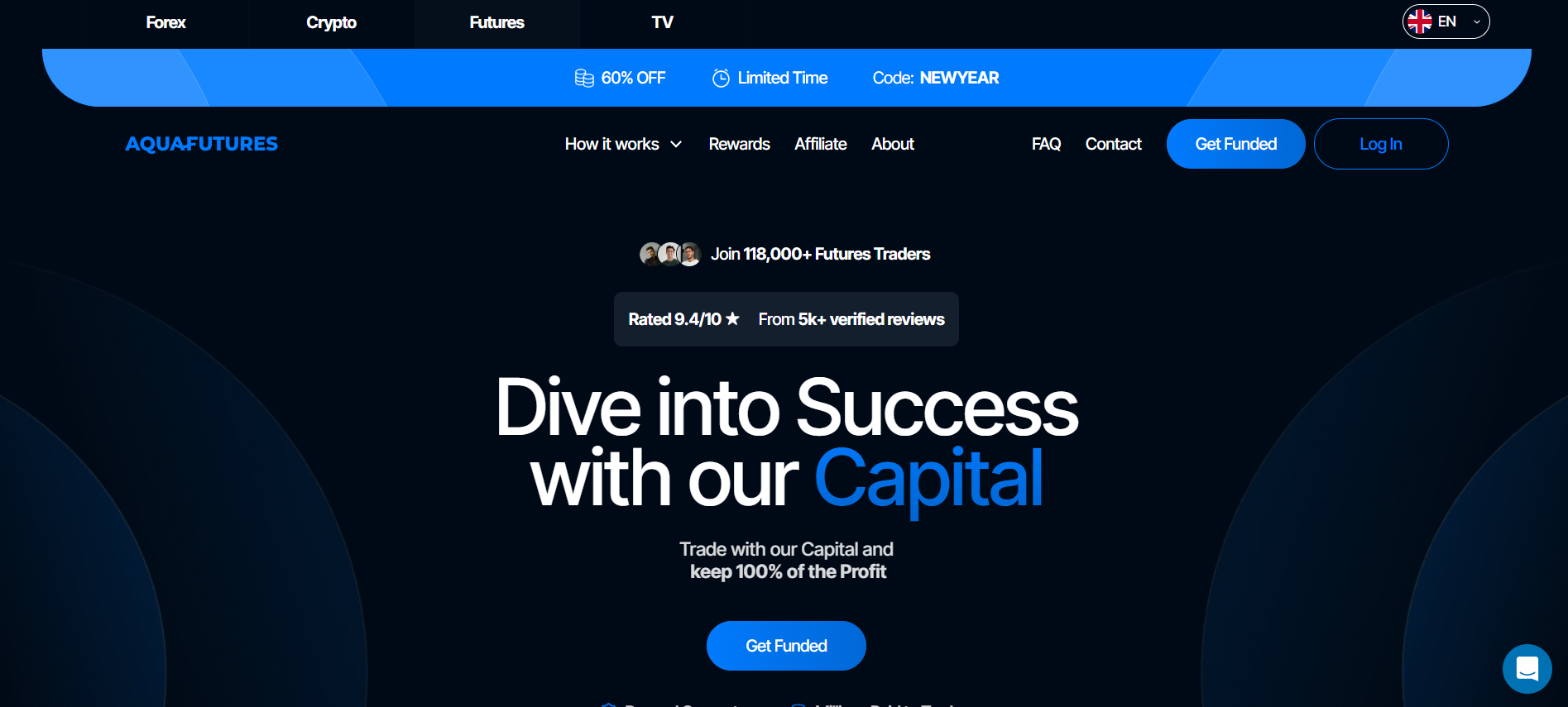
AquaFutures is a leading proprietary trading firm in 2026 specializing in futures trading, providing traders with instant funding or one-step challenge options to access simulated capital up to $450,000 while trading the firm's money with no personal liability for losses. It stands out in the prop trading space by offering rapid capitalization for derivatives-focused traders, full retention of the first $15,000 in profits followed by a 90% split thereafter, flexible rules with no time limits, guaranteed fast payouts (within 24 hours or receive a $500 bonus), and a commitment to transparency, reliability, and social good through charitable initiatives supporting ocean cleanup and clean drinking water access.
With over 118,000 traders joined, a 9.4/10 rating from 5,000+ verified reviews, and more than $5,000,000 in total rewards paid out (average $2,450, highest $119,175), it appeals to those seeking quick, trustworthy access to substantial scaling in futures and related markets like forex, indices, metals, and crypto.
Key Features
- Instant funding option to bypass challenges entirely for immediate access to funded accounts.
- Account sizes range from $25,000 to $150,000 initially, scaling up to $450,000 in funded capital.
- Profit split: 100% on the first $15,000 in profits, then 90% ongoing.
- No time limits or minimum trading days; unlimited trading period.
- Flexible drawdown rules including max drawdown (e.g., 4% or $1,000 on $25k accounts), daily loss limits (e.g., 2.5% or none in Pro modes), trailing or end-of-day modes.
- Position limits based on account size (e.g., 1 contract on $25k up to 15 on $150k).
- Tradable instruments: Primarily futures/derivatives, plus forex, indices, metals, and crypto.
- Supported platforms: ProjectX (with advanced charting, Tilt Indicator, bracket orders) and Volumetrica (or Quantower mentioned in contexts).
- Payouts: On-demand with no fixed schedule, processed in 24 hours or a $500 bonus if delayed; weekly options available; reward guarantee, and no denials.
- Pricing starting from $26/month for smaller accounts, one-time fees for others, with promotions like 60% off discounts.
- No activation fees, no hidden costs, no reset fees.
- Educational resources: Free live trading shows via AquaTV, promotions, giveaways, and insights from funded traders.
- 24/7 support through Discord, social media, website chat, and email, with fast responses.
- Charitable impact: Contributions to sea conservation and clean hydration efforts.
- High community trust: 118,000+ traders, 9.4/10 rating, millions in verified payouts.
Why Traders Choose AquaFutures as Their Best Choice
Traders select AquaFutures as their top prop firm in 2026 for its unbeatable combination of speed, transparency, and trader-first policies that minimize barriers while maximizing earning potential and security. The instant funding bypass eliminates lengthy evaluations, allowing immediate trading with real rewards on the firm's capital and zero personal risk for losses—ideal for futures traders eager to iterate strategies quickly. Generous profit retention (full on the first $15,000, then 90%) paired with guaranteed rapid payouts (24-hour assurance with a bonus penalty for delays) and no denials builds unmatched payout confidence, evidenced by over $5M disbursed and high average rewards.
Unlimited trading time, flexible drawdowns, no hidden rules, low entry costs from $26/month, and scaling to $450k support sustainable growth without pressure. Add 24/7 responsive support, educational AquaTV sessions, and positive environmental giving, and it becomes the preferred choice for disciplined traders prioritizing reliability, fast access to capital, clear conditions, and ethical alignment in the competitive prop trading landscape.
2. Apex Trader Funding

Apex Trader Funding excels in futures trading, offering micro/small contract trading during evaluations and up to 20 concurrent funded accounts post-qualification. Traders keep 100% of the first $25,000 in profits per account and 90% thereafter, with broad platform support and lenient rules like trading during news and holidays.
Key Features
- Funded account sizes range from $25,000 to $300,000+ with high scaling potential up to millions in some setups.
- Flexible trading windows allow activity from 6 PM ET to near market close the next day, including news events.
- Supports up to 14 platforms, including Rithmic, Tradovate, NinjaTrader, and TradingView.
- Multiple accounts manageable simultaneously with independent data feeds.
- No strict consistency rules, enabling diverse strategies.
- High profit split starting at 90% after the initial threshold.
- Strong reputation for reliable payouts and low restrictions on holding positions.
3. SabioTrade
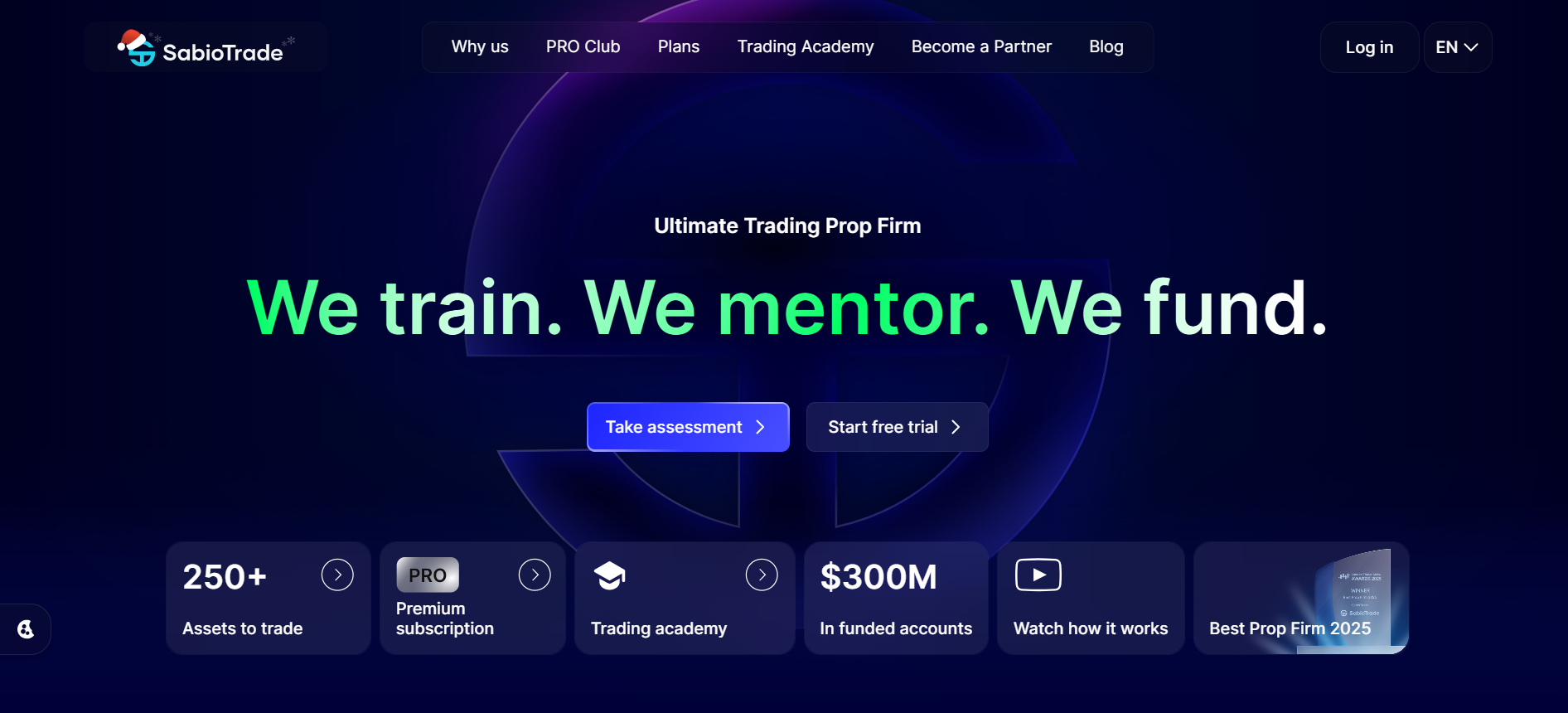
SabioTrade offers a streamlined one-step evaluation, with some of the lowest entry fees in the industry (starting at around $95 for $20,000 accounts), and access to over 250 instruments. It stands out with an all-in-one dashboard, advanced charting tools, and robust educational resources for skill-building.
Key Features
- Unified platform integrates funding management, education, and trading tools.
- Advanced charting with Heiken Ashi, multiple timeframes, economic calendars, and custom alerts.
- Educational suite includes recorded sessions, webinars, podcasts, and mindset training.
- 24/7 multilingual support for global traders.
- No minimum trading days or time limits on evaluations.
- Competitive profit splits up to 90% with fast processing.
- Broad instrument coverage across forex, indices, commodities, and more.
4. OneFunded

OneFunded provides simulated funded accounts from $2,000 to $100,000 with realistic market conditions, no time limits, and up to 90% profit shares. It's highly user-friendly for both beginners and pros, emphasizing flexible rules, quick payouts, and sustainable growth.
Key Features
- Low entry costs starting at $23 for small accounts.
- Allows news trading, overnight holds, and EAs/automation.
- Unlimited time to pass evaluations at your own pace.
- Fair, real-market-like challenge conditions without artificial barriers.
- Fast payouts with on-demand options in many cases.
- Scalable accounts with performance-based growth.
- Strong focus on trader support and community resources.
5. For Traders

Launched in 2023, For Traders has become a go-to for beginners with accessible forex, crypto, and futures trading via MT5, cTrader, TradeLocker, and custom futures platforms. It features proprietary technologies such as AI analytics, real-time insights, and a sophisticated dashboard for performance tracking.
Key Features
- Built-in AI tools and live analytics for strategy refinement.
- Customizable evaluation parameters (profit targets, drawdowns).
- Guaranteed 2-day payouts once qualified.
- Active global community with forums, competitions, and events.
- Multiple platform options, including MT5 (non-US) and specialized futures interfaces.
- Transparent proprietary technology stack.
- Focus on openness and skill-building resources.
6. Funded Trading Plus
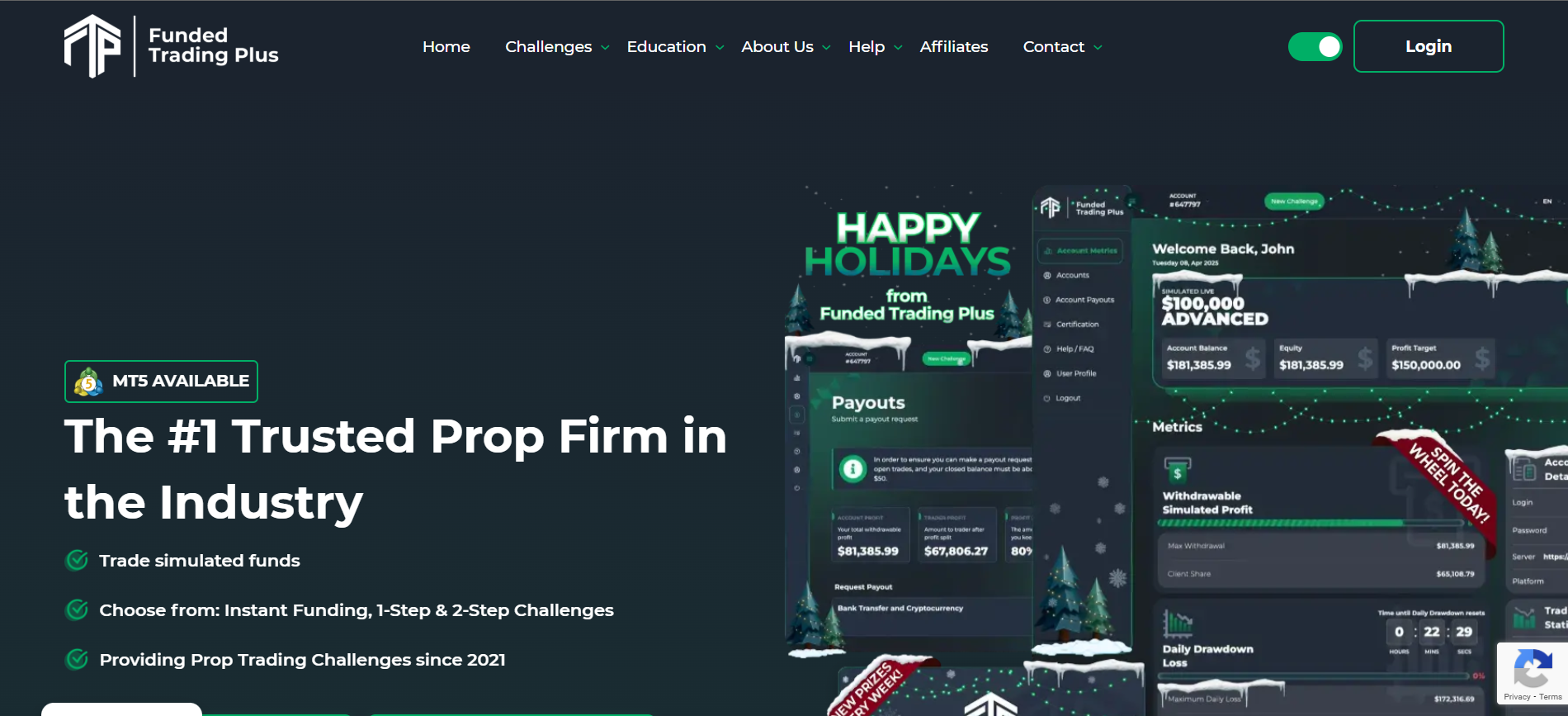
Funded Trading Plus remains a highly regarded UK-based firm in 2026, known for its diverse evaluation models (one-step, two-step, instant funding, and static drawdown options) and aggressive scaling up to $5 million or more. It offers profit shares starting at 80% and reaching 100% upon hitting performance milestones, with no time limits on challenges, a broad platform support, and a focus on trader freedom, including news trading and EAs.
Key Features
- Multiple program types, including instant funding and static drawdown for varied risk preferences.
- Exceptional scaling plan that boosts account size by 25%+ after consistent profits, up to multimillion levels.
- Fast payouts from day one, often processed in 1-2 days on 7-day or on-demand cycles.
- Supports platforms like MT5, cTrader, TradingView, MatchTrader, and DXtrade.
- High profit splits escalating to 100% with add-ons for quicker access or boosted shares.
- Transparent rules with no hidden restrictions, a strong community, and 24/7 support.
- Positive trader feedback highlighting reliability and customer experience promises.
7. BrightFunded
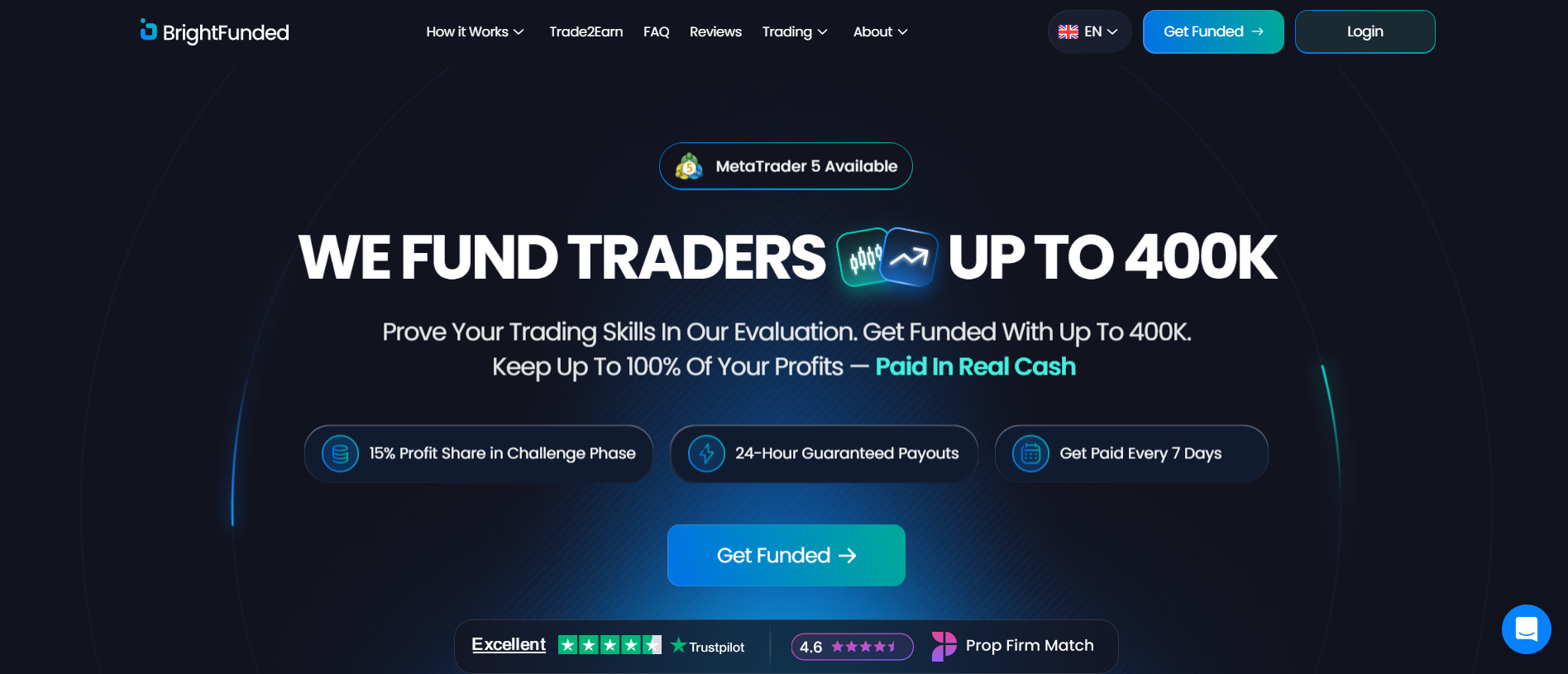
BrightFunded, a modern prop firm launched around 2023, continues to rank highly in 2026 for its trader-centric approach, dual-stage evaluations that can lead to up to $400,000 in funded accounts, and profit shares up to 100%. It offers broad instrument access (forex, crypto, indices, metals), expert-led management, weekly payouts, and unique perks, including Trade2Earn rewards for consistent performance.
Key Features
- Access to 150+ instruments, including 40+ crypto pairs, with tight spreads and favorable conditions.
- Experienced leadership team with backgrounds from central banks and top prop firms for solid oversight.
- Weekly 7-day payout availability with rapid 4-hour average processing.
- Unrestricted growth path and incentive programs granting free challenges or enhanced splits.
- Dual-stage evaluation with realistic targets and mobile/desktop cTrader/custom platform support.
- Focus on long-term trader success with educational resources and community engagement.
- High trust from reviews emphasizing transparency, fast payouts, and professional operations.
8. My Funded Futures

My Funded Futures specializes in straightforward futures trading with a single-step evaluation, no daily drawdown in many modes, and funded accounts up to $600,000 (with full retention of the first $10,000 in profits and 90% thereafter). It connects to major exchanges like CME via top platforms and offers flexible payout schedules tailored to trader needs.
Key Features
- Varied payout options: Starter after 5 profitable days, Expert after 14 days with a buffer, and customizable Milestone plans.
- Trailing or end-of-day drawdown only (e.g., 4% on $50k, 3% on larger), no daily loss caps in key modes.
- Account sizes from $50,000 to $150,000+ with multiple variants for different styles.
- Extensive platform compatibility, including Tradovate, NinjaTrader, Quantower, TradingView, and order flow tools.
- Direct access to futures markets with reliable execution and data feeds.
- Emphasis on professional guidance, abundant tools, and simple qualifications.
- Strong reputation for payouts and minimal restrictions on strategies.
9. FXIFY
FXIFY provides funded access up to $400,000 (scalable to $4 million) with 90% profit splits, no commission trading on many assets, and immediate/on-demand payouts. It supports algorithmic trading, has no consistency rules or time limits, and offers a 125% refund on challenge fees with the first withdrawal, backed by broker partnerships.
Key Features
- Zero commissions across forex, indices, metals, and other products.
- Tight spreads, high leverage, and full strategy freedom, including EAs and hedging.
- Instant first payout possible after an initial profitable trade.
- Platforms like MT4/MT5 and additional options through FXPIG integration.
- No time limits or restrictive rules for sustainable trading.
- Challenge fee reimbursement bonus, and competitive entry costs.
- Reliable, fast payouts with strong industry standing for transparency.
10. Trade the Pool
Trade the Pool focuses on stock and options trading with robust risk tools, flexible holding periods, and accounts supporting over 12,000 equities/ETFs. Launched in 2022, it caters to players of all skill levels with confidence-building mechanisms that adjust drawdowns after streaks and comprehensive educational support.
Key Features
- The confidence booster increases drawdown limits after 5 consecutive winning sessions, with tiered increments.
- Auto-adjustment lowers limits after losing streaks to protect capital.
- Multi-layered risk management covering peak daily, overall drawdown, and exposure.
- Extended trading windows and premium tools, including scanners/analyzers, are included.
- Broad equity/options access for intraday to swing strategies.
- Beginner-friendly with educational aids and varying expertise support.
- Set clear profit targets and focus on robust hazard oversight for long-term growth.
11. The 5%ers

The 5%ers, a long-established prop firm since 2016, excels in forex, metals, and indices trading, with low entry barriers, access to the MT5 platform, and profit splits up to 100% on select programs. It emphasizes sustainable growth through hyper-growth scaling, instant funding options, and a strong reputation for transparency and trader education, making it ideal for long-term scalers.
Key Features
- Full MT5 access across desktop, web, and mobile with custom enhancements.
- Global availability, including U.S. traders, as a licensed funding provider.
- Clear, defined profit targets and drawdown rules across various programs.
- Extensive performance tools, community networking, and educational resources.
- Scaling to multimillion levels with performance-based boosts.
- High profit splits (up to 100%) and challenge fee refunds on premium plans.
- Strong Trustpilot ratings and proven long-term reliability.
12. The Trading Pit

The Trading Pit offers structured evaluations with flexible single- or dual-stage challenges, access to futures and CFDs/forex, and the ability to scale up to €5 million while retaining up to 80% of profits. Award-winning for transparency and education, it supports major exchanges via advanced platforms and prioritizes trader consistency with affordable pricing and payout flexibility.
Key Features
- Choice of single- or dual-stage evaluations tailored to skill levels.
- High scaling potential up to €5 million for proven performers.
- Comprehensive educational content, including webinars, e-books, and sessions.
- Multiple platforms like MT4/MT5, TradingView, Quantower, and Rithmic.
- Futures Prime program with fewer rules, better pricing, and flexible payouts.
- Award recognition for transparency, education, and multi-asset offerings.
- Community focus with reliable execution and support for serious traders.
13. OneUp Trader
OneUp Trader offers a simple, single-step evaluation for futures trading, with account sizes from $25,000 to $250,000, 100% retention on the first $10,000 in profits, and 90% thereafter. It features broad platform support (20+ options), no daily drawdown, free data/licenses, and fast funding paths like Express in as few as 5 days, backed by strong reviews for fairness and reliability.
Key Features
- Straightforward one-step process with no daily loss limits.
- Accelerated funding via the Express option for returning or quick qualifiers.
- No hidden fees, including a free NinjaTrader license and real-time data.
- Account sizes are scaled to fit various strategies and risk levels.
- Trailing drawdown only, with flexible rules post-evaluation.
- Unlimited profit withdrawals from day one once funded.
- High Trustpilot scores emphasize transparency, support, and ease.
14. FundingPips
FundingPips has emerged as a leading prop firm in 2026, boasting over $200 million in verified trader payouts, a zero-denial rewards policy, and support for more than 2 million traders. It provides simulated funded accounts up to $300,000 with flexible evaluation models on platforms such as MT5, cTrader, and MatchTrader, prioritizing speed, clarity, and trader-centric conditions across forex, indices, and other markets.
Key Features
- High payout reliability with over $200M distributed globally and no reward denials.
- Multiple evaluation paths, including 1-step and 2-step challenges tailored to different styles.
- Supported platforms: MT5, cTrader, and MatchTrader for versatile execution.
- Generous profit splits up to 100% in top tiers or performance-based rewards.
- Instant or rapid funding options post-evaluation with no hidden restrictions.
- Broad instrument access, including forex pairs, commodities, indices, and crypto.
- Strong community and promotional incentives, such as discounts and trader events.
15. Tradeify
Tradeify ranks highly among futures-focused prop firms in 2026, known for flexible evaluation plans, trader-friendly policies, and a solid 90% profit split across account types. It offers multiple paths to funded status at competitive pricing, with minimal restrictions and a strong emphasis on reliability for US and global traders in futures markets.
Key Features
- 90% profit split standard on funded accounts.
- Flexible evaluation options with various account sizes and rules.
- Competitive challenge fees and frequent promotional discounts.
- Support for major futures platforms like Tradovate or NinjaTrader integrations.
- High max allocations, often up to $750K or more in scaling.
- Trader-focused policies with lenient drawdown and trading freedom.
- Positive verified reviews highlighting payout consistency and support.
16. FTMO
FTMO is a prop firm trusted for its transparent rules, proven track record of over $500 million in payouts, and comprehensive analytics tools. It offers funded accounts in forex, indices, and metals with up to 90% profit splits, strict but fair risk parameters, and extensive educational resources for disciplined traders.
Key Features
- Long-standing reputation with massive verified payouts exceeding $500M.
- Up to 90% profit split on funded performance.
- Multiple challenge types (e.g., Normal, Aggressive) with clear objectives.
- Advanced analytics and performance tracking tools.
- Broad platform support, including MT4/MT5 and custom apps.
- Scaling potential to higher capital with consistent results.
- Strong educational suite, community, and dedicated support.
17. DNA Funded
DNA Funded stands out in 2026 for its focus on TradeLocker trading, offering modern platforms, flexible rules, and competitive conditions for forex and other CFD markets. It appeals to traders seeking innovative tools and straightforward progression to funded accounts with reliable payouts.
Key Features
- Specialized in the TradeLocker platform for enhanced user experience.
- Flexible challenge structures with 1-step or multi-phase options.
- Competitive profit splits and scaling opportunities.
- Support for diverse instruments like forex, indices, and commodities.
- Fast payout processing with transparent policies.
- Modern dashboard for account management and analytics.
- Positive feedback on platform stability and trader support.
18. E8 Funding
E8 Funding (including E8 ETF options) provides versatile funding up to $500,000, with profit splits up to 100% in higher tiers, supporting multiple platforms such as MT5, Match-Trader, cTrader, and TradeLocker. It's ideal for advanced traders valuing customization in evaluations and broad market access.
Key Features
- High scaling to $500,000+ with strong profit retention.
- Multiple evaluation steps (1/2/3-phase) for tailored approaches.
- Platforms: MT5, cTrader, Match-Trader, TradeLocker.
- Instruments covering forex, indices, metals, and more.
- Up to 100% profit split in performance-based models.
- Flexible rules with add-ons for custom conditions.
- Solid reputation for reliability and trader resources.
What Makes a Prop Trading Firm the Best Choice?

The best prop trading firm supports consistent, skilled traders through fair structures. For U.S. traders, this means focusing on trading setups with realistic goals, strong risk safeguards, reliable earnings access, quality trading tools, and overall trustworthiness: key factors that help traders identify dependable firms in a market with limited oversight.
Key Point: The most successful prop traders prioritize firm reliability over flashy profit promises, as sustainable trading careers depend on consistent support rather than unrealistic expectations.
"Trustworthy prop firms focus on long-term trader development rather than quick profits, creating sustainable partnerships that benefit both parties." — Industry Analysis, 2024
Warning: Many prop firms in the market operate with minimal oversight, making due diligence on risk management policies and payout reliability absolutely essential before committing capital.
What makes evaluation criteria clear and achievable?
Top-tier proprietary trading setups have evaluation processes designed to test trading skills. Profit goals range from 5% to 10% across different stages, with a minimum of 5-10 active trading days and flexible consistency rules. Many leading options now include unlimited time frames, allowing traders to perform more naturally.
How do structured assessments benefit serious traders?
This method helps dedicated traders by concentrating evaluations on skill and discipline rather than hasty choices. When rules are clear and openly shared, traders can plan effectively and build confidence, leading to higher success rates. The gap between passing and failing often depends on whether the structure respects your actual trading rhythm.
Balanced and Transparent Risk Management
Effective risk parameters balance protecting capital with trading flexibility. Typical standards include daily loss limits of 4-5% and drawdown caps of 8-10%, calculated transparently on account balance or equity highs. Companies that outline breach conditions clearly and commit to no retroactive adjustments earn greater credibility.
Proportionate controls encourage disciplined trading without being harsh. Traders perform best when risk measurement is clear, allowing confident strategy application without fear of restrictions. Unexpected or unexplained drawdown rules can erode trust and derail trading progress.
What makes cost structure and payouts reliable?
Strong options highlight affordability and dependability. Evaluation fees range from $50 to $500 based on account size, avoiding recurring monthly charges. Profit-sharing arrangements can reach up to a 90% profit split, with scaling opportunities that expand access to $400,000 or $1 million for proven performers. AquaFutures-funded trading accounts provide flexible scaling paths for traders seeking to maximize potential.
Payouts occur on consistent schedules (weekly, bi-weekly, or on-demand) with clear minimum thresholds and no unexpected reductions. At AquaFutures, we ensure transparent and reliable compensation for our traders.
How do dependable payouts promote sustainability?
These features promote sustainability by cutting overhead costs and ensuring traders get paid quickly. Reliable processing builds customer loyalty, as people appreciate companies that keep their promises promptly.
Many traders feel stressed about waiting weeks for payments, dealing with unexpected holds, or sudden rule changes that seem designed to profit more from trader failures than trader success.
How do traders manage payout expectations effectively?
Most traders manage payout expectations by creating financial safety nets. As trading accounts grow, payment delays heighten stress and disrupt cash flow planning.
Trading platforms like AquaFutures, which fund futures trading accounts, solve this problem by promising 24-hour payouts or giving traders an extra $500, transforming weeks-long processes into a single day while maintaining full transparency.
Superior Platform and Execution Quality
Reliable prop firms offer access to established, stable trading systems with real-time market data. They support popular trading methods such as scalping, swing trading, and automated strategies while maintaining tight slippage control, clear execution rules, and high system uptime.
Quality infrastructure directly affects trading results by reducing technical problems and enabling precise order handling. A single system error during a critical trade can erase weeks of careful risk management, highlighting the importance of robust trading platforms.
Operational Transparency and Long-Term Credibility
Trustworthiness stems from openness and a proven track record. While many operate outside direct regulatory oversight, the strongest prop trading firms share details about their legal setup, jurisdiction, team, and payout processes transparently. They maintain positive community feedback, multi-year stability, consistent payout evidence, and steady core guidelines. Forbes councils emphasize that ethical practices and transparency form the foundation of trust in proprietary trading environments.
Firms with long-standing track records focus on sustainable value rather than short-term hype. Traders benefit most from those who demonstrate reliability through consistent action. Failed firms typically share common traits: unclear terms, frequent rule changes, unresponsive support, and revenue models designed to prevent traders from reaching payout thresholds.
Our content update strategically improves the article's relevance and search performance by addressing key information gaps.
Analysis of top-ranking posts reveals critical information missing from our content, which we can add to improve reader value and search visibility.
We will include targeted content to address user search intent and knowledge needs.
Related Reading
- Basic Trading Strategy
- Spot Algorithmic Trading
- Forex Trading Profit Per Day
- Crypto Trading Bot Strategies
- Best Forex Trading Bots
- Fair Value Gap Trading Strategy
- Best Leading Indicators for Day Trading
- Best Indicators for Swing Trading
- Best Charting Software for Day Trading
- Best Indicators for Options Trading
- Fair Value Gap Trading Strategy
How to Choose the Best Prop Trading Firm For Your Needs
Pick the firm that lets you run your strategy under live conditions, proves its rules in action, and gives you the numbers you can fold into your edge. If a provider cannot show execution artifacts, clear fees, and consistent rule enforcement, treat everything else as marketing.
How do I stress-test a firm before I commit?
Start with a controlled live cycle, small size, and short window, and treat it like a product acceptance test. Place a handful of real trades across your usual entry and exit types during high- and low-volatility sessions, record fills, and compare fills to published quotes to measure slippage. Open a live support ticket about an execution issue and time the response, then escalate to request a full log excerpt for the exact trades, because how support handles that first ticket predicts later crisis handling. Think of it like kicking the tires at night and listening for odd sounds; if something squeaks now, it will scream under pressure.
What contract clauses actually change your bottom line?
Ask for a plain-English fee schedule that lists per-trade commissions, platform or data fees, withdrawal charges, and any profit-share triggers. Then run a simple back-of-envelope model: net equals gross profit times your split, minus commissions, slippage, and fixed platform fees. Use your historical average trade frequency and win per trade to assess whether the firm’s economics support sustainable growth. Cost clarity matters deeply because MarketMates reports that over 70% of traders consider cost transparency crucial when choosing a prop trading firm. You should not sign until every recurring or conditional charge is spelled out and quantified.
How do I verify risk enforcement actually behaves as the rulebook says?
Risk rules are where promises meet the real market. Request historical enforcement logs or anonymized examples of violations, and ask how daily loss caps are applied in Greeks: is the cap evaluated on end-of-day mark, on intraday worst-equity, or via trailing measures? Risk management dominates outcomes; according to World Business Outlook, 95% of successful traders cite risk management as a key factor in results, so insist on seeing the precise mechanism you will be judged against before trading larger sizes. This avoids the common trap where a rule looks generous on paper but is implemented in a way that repeatedly stops your method.
Most traders validate a firm by reading the rulebook and trusting support emails, because that approach feels familiar and fast. As accounts scale, that habit creates hidden costs: ambiguous enforcement, inconsistent appeals, and surprise interpretations of the rules that undermine strategies and erode confidence. Platforms like funded accounts for futures trading compress that friction by offering transparent simulated-capital rules, clear escalation paths, and instant funding options so traders can validate behavior quickly while preserving auditability.
What operational proofs should I demand, beyond the PDF?
Get order replay, venue-level fill logs, and a recent timestamped payout record. Ask whether the platform provides a sandbox API or time-limited demo credentials so you can run automated strategy tests against their matching engine. Test reconnect behavior, because a recovery routine that blanks orders or duplicates fills will destroy a short-horizon system faster than bad analysis. If they cannot provide these artifacts within a reasonable window, assume their operational hygiene will be a recurring liability.
How should I choose support and recovery mechanisms that preserve performance?
Plan for human friction as part of risk control. If losing an account is possible, you must know the firm’s appeal timeline, retraining or simulated re-entry options, and whether they offer trade reviews or coaching after a breach. This is not softness; it is survival. Traders burn out after a blow because financial losses feed self-doubt, and a predictable recovery path with concrete steps and deadlines restores momentum faster than vague promises.
What final proof-of-fit seals the deal?
Run a small live lifecycle: trade, request fills, make a small withdrawal or simulated payout request if available, and escalate a support issue. If the firm produces coherent logs, answers on time, and applies rules exactly as written, you have behavioral proof, not hope. If anything feels negotiable or fuzzy, walk away; you want a partner where the operational evidence matches the marketing.
The frustrating part? This still leaves one crucial question unanswered about the deal you sign.
Unlock up to 50% off Your First Funded Account for Futures Trading
Consider AquaFutures if you want to scale your futures trading without another evaluation gauntlet. Test a small, funded account for one trading week to see how live support, execution logs, and payout responsiveness affect your edge. We recommend treating it like a flight check: compare those results against other top prop trading firms and use introductory pricing to keep downside small while you verify the fit.
Related Reading
- Fibonacci Trading Strategy
- ORB Trading Strategy
- Crypto Swing Trading Strategy
- Best Copy Trading Platform
- Best Proprietary Trading Firms for Beginners
- Best Stocks for Options Trading
- Silver Bullet Trading Strategy
- Order Block Trading Strategy
- The Strat Trading Strategy
- Supply and Demand Trading Strategy
- Profitable Gold Trading Strategy
- Higher High Lower Low Trading Strategy
