



Top 10 Prop Firms in the World for Funded Trading in 2026
Top 10 Prop Firms in the World ranked by AquaFutures experts. Compare funding limits, profit splits, and requirements to find your match.

Proprietary trading firms have transformed how traders access capital, allowing them to trade with substantial funds without risking personal savings. These firms provide traders the opportunity to use company money while keeping a significant portion of the profits. Understanding what a funded account is can help traders scale their operations with minimal personal financial exposure while developing their skills in live market conditions.
Futures traders benefit from funded accounts that provide real capital specifically designed for commodities, indices, and other futures contracts. The firm absorbs downside risk while traders focus on developing consistent, profitable strategies. AquaFutures offers a streamlined approach to accessing funded accounts for futures trading without lengthy evaluation processes or excessive fees.
Summary
- Proprietary trading firms supply capital to skilled traders without requiring personal funds at risk, with the firm absorbing losses while taking a share of profits. This structure aligns incentives in ways traditional brokerages never could, turning consistent performance into scalable income for traders who can prove discipline under pressure. Most firms require evaluation phases in which traders hit profit targets of 6% to 10% while staying within daily drawdown limits of 3% to 5% and total drawdown limits of 6% to 10%, filtering for repeatable processes rather than lucky streaks.
- The prop trading industry grew into a $12 billion market by mid-2025, with global monthly searches for "prop firm" jumping from 880 in early 2020 to 49,500 by 2025. This explosive growth attracted both legitimate operators and predatory firms, leading to a massive shakeout where 95% of prop firms that existed in early 2024 had either shut down or drastically changed their business models by the end of 2025. The survivors tend to balance profitability with fair terms, creating systems in which skilled traders can actually withdraw earnings rather than cycle through endless resets.
- Payout speed reveals everything about a firm's operational integrity and its confidence in cash flow. Firms that guarantee withdrawals within 24 hours or compensate for delays with bonuses signal respect for traders' time and sustainable business models, while those imposing vague processing timelines or sudden verification requirements often prioritize liquidity over traders' access to earnings. A 90% profit split paid in 24 hours beats a 95% split that takes three weeks and requires repeated follow-ups, because speed compounds trust and demonstrates systems work under pressure.
- Pass rates below 8% suggest evaluation rules calibrated to extract fees rather than fund traders. The strict drawdown limits and profit targets that protect firm capital also constrain strategies, particularly those that require wider stop-losses or longer holding times. Traders who pass evaluations by playing it safe sometimes abandon that discipline once funded, chasing larger gains to accelerate payouts in a psychological shift that often leads to blown accounts despite proven skill during the challenge phase.
- Capital access through prop funding removes the psychological trap of trading personal savings, where every loss threatens financial security and distorts decision-making. A trader generating 5% monthly returns on a $100,000 funded account earns $5,000 per month at an 80% split, far exceeding what most could achieve risking their own capital, with downside capped at evaluation fees while upside scales with skill. This asymmetry attracts global talent, particularly from regions where traditional employment offers limited income growth and personal savings can't meet the requirements for professional-level positions.
- Funded accounts for futures trading address these dynamics by offering instant funding or simple one-step challenges with transparent profit splits starting at 100% on initial earnings, backed by 24-hour payout guarantees that eliminate withdrawal anxiety and let traders focus on execution rather than navigating bureaucratic friction.
What are Prop Firms, and How Do They Work?
Proprietary trading firms provide capital to traders who demonstrate skill, enabling them to trade futures, forex, or crypto without risking their own money. In exchange, the firm takes a share of profits while absorbing losses. The structure converts consistent performance into scalable income, provided you can prove discipline under pressure.
🎯 Key Point: Prop firms essentially act as talent investors - they provide the capital while you provide the trading expertise, creating a mutually beneficial partnership where skill translates directly into earning potential.

"Proprietary trading firms have become the primary pathway for retail traders to access institutional-level capital without the traditional barriers of minimum deposits or personal risk exposure." — Trading Industry Analysis, 2024
💡 Example: A trader might receive $100,000 in trading capital after passing a challenge phase, then keep 70-80% of all profits while the firm covers any losses up to their maximum drawdown limits.

How do the top 10 prop firms in the world align trader incentives?
The model aligns incentives: firms profit when traders succeed, unlike traditional brokerages, where you pay commissions and face a counterparty that wins when you lose. The firm wants your account to grow because your gains become theirs, shifting the relationship from transactional to collaborative. The entry bar remains high by design.
How Capital Allocation Actually Works
When you apply to a prop firm, you don't receive funding immediately. Most require an evaluation phase where you trade a simulated account under strict rules: hit a profit target, stay within drawdown limits, and follow position-sizing guidelines. The firm uses this to identify traders who can manage risk when real capital is at stake.
What are the evaluation costs and success rates?
The evaluation typically costs an entry fee ranging from a few hundred to over a thousand dollars, depending on account size. If you pass, the fee is often refunded with your first payout. If you fail, you lose the cost and time invested. According to Investing.com, 95% of prop firms that existed in early 2024 had either shut down or drastically changed their business models by the end of 2025. The survivors balance profitability with fair terms, creating systems that allow skilled traders to withdraw earnings.
How do the top 10 prop firms in the world scale your account?
Once your AquaFutures account is funded, it grows based on your performance. When you hit milestones—such as generating profits for several consecutive months or reaching specific return goals—our firm allocates additional capital for trading. This system rewards consistent success over isolated gains. Our funded account follows the same risk rules as the evaluation period, but losses now use real money, and breaching drawdown limits can result in account suspension or closure.
Profit Splits and Payout Mechanics
Profit sharing typically ranges from 10% to 30% kept by firms after you reach withdrawal thresholds, though competitive firms offer 80% splits. Initial payouts require meeting criteria, such as a minimum number of profitable trading days or holding positions for a set duration, to prevent exploitation of loopholes.
How do the top 10 prop firms in the world process withdrawals?
Payouts process regularly—usually every two weeks or monthly—via bank transfer or payment platforms. Firms that delay withdrawals or impose hidden conditions erode trust and distract from trading. The best structures let you access earnings quickly once rules are met, reinforcing that skill translates directly to income. Top performers can manage six-figure accounts and keep the majority of profits, scaling initial evaluation capital into a legitimate trading business.
The Evaluation Gauntlet
Passing an evaluation means demonstrating consistent profitability under real constraints. You'll need to generate profits of 6% to 10% of your account balance while adhering to daily loss limits (3% to 5%) and maximum drawdown caps (6% to 10%). These rules enforce smaller position sizes, prevent revenge trading, and encourage selective entry into trades. Many traders excel on practice accounts but fail here because live pressure exposes weak discipline. Our funded futures accounts enforce these discipline requirements. Learn more about conservative position sizing to improve your chances of success.
How do the top 10 prop firms in the world affect trader psychology?
The change in how traders think and feel is significant. Losses are no longer abstract—every trade carries real weight because of entry fees and the risk of starting over if you break a rule. Traders often abandon the discipline they showed during evaluations when moving to funded accounts. This pattern shows that trading success depends more on mental endurance than technical skill.
Why do firms filter so aggressively during evaluations?
Companies filter traders aggressively during this phase, looking for repeatable processes that generate profits without depleting accounts. If you can't handle evaluation constraints, you won't survive the pressure of trading a funded account. This filter protects both the company's capital and your potential earnings by ensuring only prepared traders advance.
Why do prop firms choose to absorb trader risk?
The prop firm model exists because capital is abundant, but skilled risk management is scarce. By funding your account, firms like AquaFutures hire you as a performance-based contractor, paying only when you deliver results. This structure lets them scale across hundreds or thousands of traders, spreading risk while capturing upside from the percentage who consistently profit.
How does funded trading benefit individual traders?
For you, this means access to leverage and position sizes that would take years to build with your own savings. A $100,000-funded account lets you trade with serious money while your downside remains limited to rule violations, not to financial ruin. The firm absorbs losses if you blow the account within its guidelines. It's a calculated bet that enough traders will succeed to offset those who don't, creating a profitable system where skill gets rewarded at scale.
How has the prop trading model evolved over time?
In the past, prop firms hired traders as employees and provided salaries and training programmes. Today's model uses technology and remote access, shifting to evaluation-based systems that lower barriers to entry while placing more risk on traders through upfront fees. This has opened opportunities for retail traders worldwide but created quality variations across firms, making research essential before committing your time and money.
When the Model Breaks Down
Not all prop firms operate with integrity. Some design evaluations are nearly impossible, making money mainly from entry fees rather than trader success. Others impose payout conditions so restrictive that funded traders rarely withdraw, turning the promise of capital into a mirage.
What red flags should you watch for when choosing from the top 10 prop firms in the world?
Red flags include unclear withdrawal terms, frequent rule changes during evaluation, or firms that disappear after collecting fees. The 2025 shakeout mentioned earlier eliminated many predatory operators, though new ones continue to emerge.
How can evaluation requirements become a trap for traders?
The evaluation itself can become a trap if you're unprepared. Failing multiple attempts drains money and confidence, creating a cycle where you chase losses instead of building skill. Strict drawdown limits protect the firm but constrain strategies, particularly those that require wider stop-losses or longer holding times. If your edge relies on flexibility that the evaluation doesn't permit, you'll struggle regardless of talent.
What psychological pressures affect funded traders after passing evaluations?
Even after securing funding, performance pressure can alter how traders make decisions. Traders who passed evaluations through discipline sometimes abandon that approach once funded, chasing larger gains to accelerate payouts. This psychological shift from "get funded" to "maximize withdrawals" often leads to blown accounts. The firm's risk management rules cannot prevent poor judgment when traders ignore their own process.
Choosing a Firm That Backs You
The difference between a firm that supports your growth and one that takes fees lies in its clarity and honesty about what it does. Look for clear payout terms, fair evaluation criteria, and responsive support. Firms that guarantee fast withdrawals or offer bonuses for delays signal confidence in their systems. Those who hide behind unclear policies or make contact difficult are betting you'll give up before demanding what you've earned.
How do the top 10 prop firms in the world structure their evaluations?
How hard the evaluation is should match the amount of money offered. A $10,000 account with a 10% profit target and 5% drawdown is aggressive but fair. A $200,000 account with the same rules but no scaling milestones is likely designed to fail. Compare the risk-reward balance across different firms, considering entry costs, profit splits, and scaling speed. The cheapest evaluation is not always the best deal if payout conditions erode your earnings.
Why does support infrastructure matter for funded traders?
Support infrastructure matters more than most traders realize. When you're in a funded account and encounter a platform issue or need rule clarification, waiting days for a response creates stress that affects your trading. Firms offering 24/7 support and fast email responses treat you like a partner, not a transaction. This operational reliability becomes critical when your income depends on uninterrupted access to capital and timely withdrawals. The real test of a firm's commitment shows up in how they handle the transition from evaluation to funded status, and whether their rules serve traders or protect profits.
Related Reading
- What Is a Funded Account
- Does Ftmo Offer Instant Funding
- How to Get a Funded Trading Account
- No Challenge Prop Firm
- Funding Traders Rules
- What Is a Prop Firm Account
- Synthetic Funded Account
- What is a Funded Firm
- One Step Prop Firm Challenge
- Trading Challenges
- Instant Funding Rules
- Prop Firm Ip Address Rule
- Halal Prop Firms
- Top 10 Prop Firms 2025
- Australia Prop Firm
- Cheapest Futures Prop Firm
- No Activation Fee Prop Firm
- Prop Firms In Usa
- Prop Firms That Allow Trade Copiers
- Best Prop Trading Firms
- Forex Prop Firms With Instant Funding
- Best Prop Firms For Forex
- Best Prop Firm To Start
- Best Instant Funded Prop Firm
- Best Prop Firms in UAE
Why Do Traders Around the World Look for Prop Firm Funding
Traders seek prop firm funding because it removes the biggest barrier to reaching their potential: accessing real money to trade with.
🎯 Key Point: Prop firms eliminate the capital barrier that prevents talented traders from scaling their strategies and achieving meaningful profits.

"Access to capital is the single greatest challenge facing retail traders who want to transition to professional-level trading." — Trading Industry Analysis, 2024
💡 Tip: Prop firm funding allows traders to focus on what they do best — executing trades — without worrying about personal financial risk or limited account sizes.

How does capital scaling change trading outcomes?
A skilled trader with $5,000 can execute a strategy, but the same strategy with $100,000 changes what's possible in income, risk management, and career trajectory. Prop firms bridge that gap, offering capital in exchange for a share of profits while protecting traders from financial devastation.
Why do the top 10 prop firms in the world attract global traders?
Passing an evaluation proves your edge isn't luck, transforming trading from a side hustle into a legitimate business. For traders in areas where personal savings cannot meet professional-level position-sizing requirements, prop funding becomes the only realistic path to scale.
Capital Access Without Personal Risk Exposure
Trading with your own money creates a psychological trap. A $2,000 drawdown on a $10,000 account isn't 20% of your capital—it's rent money or savings you spent years building. That emotional weight distorts decision-making, turning disciplined traders into cautious ones who exit winners too early and hold losers too long out of fear.
How do the top 10 prop firms in the world change trading psychology?
Prop firms flip this dynamic. You're trading the firm's capital, so losses don't threaten your financial security. When you're not worried about losing your mortgage payment, you can execute your strategy with the consistency it requires. The prop trading industry has grown to $12 billion, driven largely by traders seeking a separation between personal finances and trading capital.
What are the real risks and rewards?
The risk transfer isn't complete: you still pay evaluation fees, and failing costs time and money. But the downside caps at that entry cost, while the upside scales with your skill. A trader generating 5% monthly returns on a $100,000 funded account earns $5,000 per month at an 80% split, far exceeding what most could achieve risking their own savings. That asymmetry attracts talent globally, particularly in markets where traditional employment offers limited upside.
How do profit splits reward consistency among the top 10 prop firms in the world?
Most prop firms offer profit splits between 70% and 90%, with top performers keeping the majority of their earnings. Some firms, as noted by Atmos by Taurex, provide a 90% profit split, allowing traders to keep nearly all their earnings while the firm takes a small percentage for providing capital and infrastructure. This structure aligns incentives in a way that retail brokerages cannot: the broker profits from your volume regardless of whether you win or lose.
How do profit splits improve as traders scale?
The split improves as you grow. Traders who regularly reach their goals often negotiate better deals or automatically receive higher percentages as their account size increases. A trader managing $200,000 at a 90% split who makes 8% monthly returns keeps $14,400 per month, generating a six-figure annual income without risking personal capital at that scale.
Why does payout speed matter as much as profit splits?
How fast you get paid matters as much as how much you get paid. Companies that process withdrawals within 24 hours treat your earnings like real income, not a special favour. Delays or hidden conditions signal a company that profits more from evaluation fees than from trader success. When a funded account for futures trading guarantees payouts within 24 hours or pays you $500 for missing that deadline, it demonstrates confidence in their systems and respect for your time. Our AquaFutures platform prioritizes fast, reliable payouts so you can access your earnings when you need them.
How do scaling opportunities work with funded accounts?
Funded accounts start at $25,000 or $50,000, but consistent performance unlocks growth opportunities. Hit profit targets over several consecutive months without exceeding drawdown limits, and firms will increase your allocation, sometimes doubling or tripling your capital. This progression lets traders expand their business without additional personal investment, converting steady results into exponential income growth.
What scaling requirements do the top 10 prop firms in the world typically have?
The scaling path varies by firm. Some require three profitable months to unlock the next tier; others use specific return thresholds or minimum trading-day counts. The best structures make scaling achievable without requiring perfection, recognising that skilled traders have flat months. Firms that scale too slowly or impose unrealistic criteria trap traders at lower capital levels, limiting income potential despite proven consistency.
Why does institutional-scale access matter for serious traders?
This matters most for traders who have outgrown retail accounts but lack sufficient capital for institutional trading. A trader managing $200,000 in funded capital works with serious money while the firm assumes the risk. That access, which would take years to build through personal savings, becomes available within months for those demonstrating repeatable skill. The firm bets your ability will generate returns justifying the capital allocation, creating a win-win arrangement where both parties profit from your growth.
What advanced tools do top prop firms provide traders?
Prop firms provide traders with tools most individuals cannot afford: advanced platforms, fast execution, institutional-grade data feeds, and proprietary analytics. These resources enable better decision-making and faster trade execution in quick-moving markets where milliseconds determine fill prices. Lower trading costs, negotiated through the firm's volume, reduce commission drag on each trade.
How do the top 10 prop firms in the world accelerate trader development?
Many firms offer educational resources, trading communities, or mentorship from experienced traders. Access to a network of peers facing similar challenges creates accountability and knowledge sharing that isolated retail traders lack. This support structure helps newer traders refine their approach more quickly, compressing years of costly mistakes into a shorter learning curve.
Why does operational reliability matter for prop trading success?
Infrastructure only matters if it works when you need it. Platforms that crash during busy trading times, slow data feeds, or unresponsive support lose their advantage. Companies that offer 24/7 support and fast response times understand that trading happens around the clock, not just during business hours. When you're in a trade and need help immediately, waiting creates stress that affects your trading decisions, turning operational problems into real trading losses.
Geographic and Financial Barriers Removed
Traders in regions with limited access to capital markets or restrictive financial regulations find prop funding particularly valuable. A skilled trader in Southeast Asia or Eastern Europe might have the edge to compete globally, but lacks the local infrastructure or savings to trade at a meaningful scale. Prop firms democratise access, requiring only internet connectivity and proven skill rather than geographic proximity or existing wealth.
How do the top 10 prop firms in the world level the playing field?
A trader in Brazil with a 15% annual return track record can access the same capital as someone in New York, competing purely on results rather than location or connections. The evaluation process judges performance objectively, removing biases that plague traditional hiring. Your background doesn't matter; your ability to manage risk and generate returns does.
Technology eliminated geographic constraints through remote trading, cloud-based platforms, and instant communication. A firm in London can fund a trader in Manila as easily as it can fund one across the street. This opened the industry to global talent, but traders now compete against the best performers worldwide, raising the bar for what "consistent profitability" means.
What challenges remain despite global access?
But access alone doesn't guarantee success, and the legal landscape surrounding prop funding varies widely across borders, creating risks most traders overlook until it's too late.
Are Prop Firms Legal Around the World?
Prop firms operate legally in most places when set up as service providers offering evaluations in exchange for access to their own capital. They are not investment managers handling client funds—a crucial distinction that keeps them outside the heavily regulated area of brokerages, hedge funds, or advisors, allowing them to function under general business and consumer protection laws.
"Prop firms maintain legal status by positioning themselves as service providers rather than investment managers, operating under general business laws instead of financial regulations." — Financial Services Analysis, 2024

🔑 Key Takeaway: The legal framework for prop firms is fundamentally different from that of traditional financial institutions because they use their own capital rather than managing clients' investments.
⚠️ Important Note: While prop firms are generally legal, regulatory requirements can vary significantly by jurisdiction and may change as the industry evolves.

Why has regulatory scrutiny increased for the top 10 prop firms in the world?
The industry's rapid growth has created confusion about its legality. Global monthly searches for "prop firm" increased from 880 in early 2020 to 49,500 by mid-2025, reflecting a market now estimated between $12 and $20 billion with over 2,000 firms operating worldwide. That expansion brought both legitimate operators and bad actors, creating regulatory scrutiny that some traders misinterpret as the model itself being illegal. Enforcement actions target deceptive practices, not the structure of providing capital to skilled traders.
What Separates Legal Operations from Regulated Entities
The legal framework depends on how the firm uses money. Prop firms provide simulated challenges that test your ability to manage risk and generate returns. Pass the evaluation, and you gain access to the firm's proprietary capital, not pooled investor funds. This positions them as performance assessment services rather than investment vehicles, keeping them outside securities regulations in most regions.
How do prop firms differ from traditional brokers?
Traditional brokers and investment managers face strict oversight because they handle client money, execute trades on behalf of others, or provide personalized financial advice. Prop firms do none of these: you trade the firm's capital under their rules, and they bet on your skill, generating returns that justify the allocation. This relationship, structured as a service agreement rather than a financial product, creates the legal pathway most firms operate within.
What happens when the top 10 prop firms in the world cross legal boundaries?
Problems arise when companies blur these lines. Misrepresenting the service as guaranteed returns, failing to disclose terms clearly, or structuring payouts as investment schemes can trigger regulatory action. The 2023 CFTC case against My Forex Funds targeted fraud and misrepresentation, not the concept of funding traders. Legitimate firms maintain a clear separation between evaluation services and regulated financial activities, ensuring compliance by design.
How do regulatory frameworks affect the Top 10 Prop Firms in the World?
In the United States, prop firms operate legally by trading their own money and structuring offerings as evaluation services rather than regulated investment advice. The SEC oversees securities, the CFTC handles commodities and futures, and FINRA regulates broker-dealers. Most retail prop firms avoid triggering these agencies' jurisdiction by not holding client funds, not executing trades for others, and not providing personalised investment recommendations.
What compliance strategies do leading firms use?
Futures-focused firms follow CFTC guidelines by ensuring traders work with the firm's money rather than handling outside accounts. Firms offering forex or CFD trading face greater challenges due to overlapping rules, though those focusing on futures or using offshore companies for non-US clients can meet these requirements successfully.
How does enforcement impact firm operations?
The enforcement landscape focuses on protecting consumers. Firms that make false claims about success rates, hide fees, or create impossible evaluation criteria face regulatory scrutiny. Operate transparently, deliver on promises, and structure services as skill assessments rather than financial products. Firms following this blueprint face minimal legal risk, while those who cut corners or mislead traders get shut down.
How do European and UK regulatory frameworks affect the top 10 prop firms in the world?
The EU and UK allow prop firms to operate outside MiFID II rules when they act as service providers using their own capital. The Financial Conduct Authority and ESMA don't require specific authorisation for this model, though consumer protection laws still apply. Firms must avoid misleading advertising, honour contractual terms, and operate with basic business integrity, but they don't need the heavy licensing that brokers or asset managers do.
What warnings have European countries issued about prop trading?
Some countries have issued warnings: Belgium flagged concerns about "shadow investing" risks, while Italy and Spain cautioned traders about gamified challenges that might encourage reckless behaviour. Well-organized firms continue operating in these markets, adjusting marketing to address specific concerns. European authorities prioritize transparency and consumer risk. Firms that clearly communicate terms, disclose pass rates, and demonstrate fair payout practices face little interference. Those using aggressive marketing or hiding failure rates draw scrutiny that can lead to restrictions or enforcement.
Where do the top 10 prop firms in the world operate from?
The UAE has become a centre for prop firm headquarters due to favourable business environments and straightforward company formation processes. Firms based there operate legally under local laws while serving global clients through remote access. Asia, Africa, and Latin America show growing participation, though some firms restrict traders from sanctioned countries or regions with payment processing limitations.
Why do some prop firms restrict certain regions?
These restrictions stem from broker partnerships, international sanctions, or financial crime-prevention laws rather than from bans on prop trading itself. A firm might exclude certain countries because its payment processor cannot process transactions there, or because its broker partner faces regulatory constraints in that jurisdiction. Traders often confuse these restrictions with illegality. When a firm says "we don't accept traders from Country X," it signals compliance with broader financial regulations, not that prop trading is banned there. The distinction matters because it shifts the question from "is this legal?" to "can I access it?" The answer depends on the specific firm's infrastructure and risk tolerance, not the legality of the underlying model.
How does regulatory scrutiny strengthen the prop trading ecosystem?
The industry's rapid growth attracted regulatory attention, leading to warnings, enforcement actions, and increased oversight. This scrutiny strengthens the ecosystem by eliminating bad operators and mandating transparency. Firms that pass regulatory review tend to offer fair terms, proven payouts, and sustainable business models rather than relying primarily on evaluation fees.
The low pass rate of 5 to 10% reflects an intentional design: firms need traders who consistently manage risk, not those who get lucky once. This filter protects both the firm's capital and your potential earnings. Regulatory pressure reinforces this by making it harder for firms to profit from endless evaluation cycles without funding successful traders.
What should traders look for when choosing among the Top 10 Prop Firms in the World?
For traders, this means choosing firms that welcome questions rather than hide from them. Transparent operations, clear terms, and responsive support signal legal standing and operational integrity. Firms that avoid questions, change terms frequently, or complicate withdrawals often do so because their model cannot withstand scrutiny. Most traders worry about legality when they should focus on operational reliability. Even legal firms can fail you if their systems prioritize profit extraction over trader success.
Top 10 Prop Firms in the World for Funded Trading in 2026
The best prop firms in 2026 set themselves apart through reliable operations: fast payouts, clear profit splits, easy evaluation criteria, and quick support. These ten firms consistently deliver on those fundamentals through verified payouts and structures that prioritise traders.

Rankings reflect verified reviews, documented payout volumes, and trader feedback across multiple markets. Firms guaranteeing withdrawals within 24 hours demonstrate confidence in their systems. Those offering 100% profit splits on initial earnings or 90% ongoing prioritise trader success.
🎯 Key Point: The top prop firms in 2026 prioritize operational excellence over flashy marketing, focusing on fast payouts and transparent profit sharing that benefits traders.

"Firms offering 100% profit splits and 24-hour withdrawals demonstrate the highest confidence in their trading systems and commitment to trader success." — Industry Analysis, 2026
🔑 Takeaway: When evaluating prop firms, prioritize those with verified payout histories and transparent fee structures over firms making unrealistic promises about easy profits.

1. AquaFutures

AquaFutures specializes in instant funding for futures traders and supports forex, indices, metals, and crypto. Our platform provides simulated capital of up to $450,000 without personal risk, operating on the "Your skill, our risk" principle: we take losses while traders keep substantial profit shares. With over 118,000 futures traders and a 9.4/10 rating from 5,000+ verified reviews, AquaFutures offers instant funding access, flexible rules without time limits, generous profit retention, and payouts backed by our unique reward guarantee. Traders access account sizes from $25,000 to $150,000 using ProjectX (integrated with TradingView) and Volumetrica. We emphasize transparency and no hidden fees, offer 24/7 support, and contribute to ocean cleanup and clean water initiatives with every account.
Key features
- Instant funding access to begin trading in various sizes.
- 100% profit split on the first $15,000 earned, then 90% after that.
- Reward guarantee: payouts within 24 hours or $500 compensation for delays.
- Weekly on-demand payouts with no fixed schedule and no reported denials.
- Flexible drawdown rules varying by program (for example, 4% maximum drawdown on certain accounts).
- Support for futures, forex, crypto, indices, and metals.
- Affordable entry starting around $26/month with frequent 60% off promotions.
Why Traders Choose AquaFutures
AquaFutures prioritises speed, reliability, and earning potential. Instant funding lets experienced traders skip lengthy approval processes and start earning rewards quickly. The 100% starting and 90% ongoing profit splits let you keep more of your earnings. The standout reward guarantee—payouts in 24 hours or $500 extra—builds trust. The firm has distributed over $5,000,000 in verified rewards, with documented six-figure single payouts. Traders praise responsive 24/7 support (often replying in minutes via Discord, chat, or email), clear rules with no hidden restrictions, and no personal liability for losses. The firm's charitable contributions, 118,000+ active community members, high verified ratings, and educational resources like AquaTV create a supportive environment for steady growth.
2. DNA Funded

DNA Funded has become a top choice in 2026, especially for U.S. and international traders. Its broker-backed structure through DNA Markets provides professional-level conditions, including tight spreads, a wide range of instruments, and the innovative TradeLocker platform. It earns high marks for balanced evaluation, reliable payouts, and trader support.
Key features
- Broker partnerships ensure competitive raw spreads and low commissions.
- Hundreds of tradable markets covering forex, indices, commodities, and more.
- Advanced TradeLocker platform with superior charting and fast execution.
- Flexible one- or two-phase challenges with reasonable profit targets.
- High profit splits, typically 80-90%.
- Reliable scaling options to grow funded capital.
- Strong verified trader feedback emphasizing payout consistency and responsive support.
3. Apex Trader Funding

Apex Trader Funding leads the futures segment in 2026 with substantial payout totals and a reputation for simplicity and generosity. It offers traders freedom through relaxed rules during evaluations and funded stages, making it ideal for consistent futures traders seeking high capital access and quick scaling.
Key features
- Over $500 million (and growing) in total payouts to traders.
- Generous scaling supports multiple accounts and substantial capital growth.
- Multiple account sizes with straightforward evaluation paths.
- Profit splits up to 90% or higher, including 100% on initial profits in some setups.
- Compatible with popular platforms like NinjaTrader.
- Flexible trading styles with minimal strategy restrictions.
- Proven reliability and high trader satisfaction in futures trading.
4. The5ers

The5ers maintains its position as an experienced company in the industry in 2026, with over a decade of operation and a focus on sustainable, growth-driven funding. It suits traders who value structured progression, long-term account development, and access to multiple asset classes without aggressive time pressures.
Key features
- Emphasis on long-term growth with progressive scaling opportunities.
- Substantial maximum funding allocations reaching high figures.
- Broad market coverage including forex, crypto, indices, metals, and commodities.
- Excellent community ratings, frequently 4.8/5 from thousands of reviews.
- Flexible challenge formats, often without rigid time limits.
- Transparent and consistent payout handling.
- Established longevity provides stability and trust.
5. Funding Pips

Funding Pips stands out in 2026 for its modern, trader-focused approach, offering fair conditions and strong suitability for consistent performers across instruments. It earns praise for competitive entry costs, diverse assets, and positive user experiences regarding platform options and reliability.
Key features
- Support for crypto, energies, forex, indices, and metals trading.
- Solid user ratings, commonly in the 4.3-4.7/5 range, from large volumes.
- Reasonable profit targets and evaluation structure.
- Quick transition to funded status.
- Meaningful scaling potential for larger capital.
- Favorable comments on execution quality and customer assistance.
6. Hola Prime

Hola Prime stands out in 2026 for its openness, processing speed, and global reach. It serves both forex and futures traders effectively, building trust through fast, reliable withdrawals and trader-first policies.
Key features
- Swift and reliable payout mechanisms.
- Structured programs tailored for forex and futures.
- Minimal restrictive rules to support various strategies.
- Impressive reported payout volumes.
- Competitive leverage in supported markets.
7. BrightFunded

BrightFunded has gained strong momentum in 2026 as a trader-focused firm, particularly favoured by US traders for its innovative loyalty rewards and unlimited scaling potential. Its Earn2Trade loyalty system rewards regular trading activity with tokens that unlock better profit shares or free resets, making it stand out for dedicated performers seeking long-term growth.
Key features
- Unlimited scaling program for ongoing account expansion.
- Earn2Trade loyalty system rewards regular trading activity.
- Wide range of instruments including forex, indices, and commodities.
- Flexible challenge options with reasonable targets and drawdowns.
- High profit splits, often reaching 80-90% or more with perks.
- Positive emphasis on fast and transparent payouts.
- Strong overall scoring in independent tests for US accessibility.
8. FXIFY

FXIFY positions itself as a versatile powerhouse in 2026, delivering advanced platforms and multiple evaluation paths tailored to different trading preferences. It appeals to traders who prioritise execution quality, platform variety, and supportive conditions across forex and CFD markets.
Key features
- Multiple platform choices (MT4, MT5, and others) for flexibility.
- Various challenge types for different trading styles (scalpers, swing traders, etc.).
- Competitive profit splits up to 90%.
- Broad asset coverage (forex, indices, metals, and energies).
- Reasonable drawdown rules and no excessive time pressures.
- Frequent promotions and discounts on entry fees.
- Solid reputation for dependable payouts and trader assistance.
9. Blueberry Funded
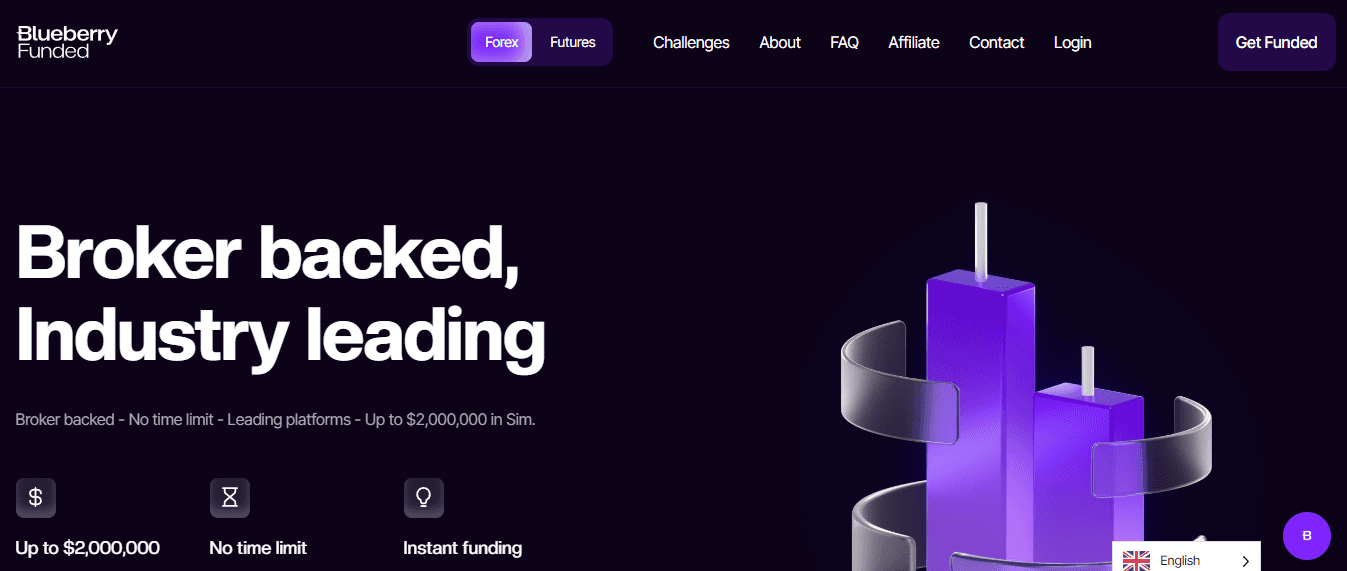
Blueberry Funded performs well in 2026, thanks to its broker-backed reliability and strong performance across CFDs and futures. It offers tight spreads and professional conditions, standing out for transparency, competitive leverage, and quick, consistent withdrawals.
Key features
- Broker partnership offering low spreads and reliable execution.
- Support for forex, CFDs, futures, and additional markets.
- Attractive profit splits of 80-90%.
- Flexible scaling to higher capital levels.
- Fast payout cycles, often bi-weekly or better.
- Trader-friendly rules with balanced risk parameters.
- High marks in reviews for stability and support.
10. Topstep

Topstep remains a cornerstone in the futures prop space in 2026, known for its longevity, educational resources, and structured path to funded trading. It prioritizes discipline and consistency, providing traders with simulated environments, coaching tools, and reliable payouts.
Key features
- Long-established reputation with extensive trader education.
- Focused on futures markets with clear performance metrics.
- Profit splits up to 90% or more after initial periods.
- Multiple account sizes and straightforward evaluation.
- Strong emphasis on risk management and journaling tools.
- Consistent and transparent payout processes.
- High trust from the futures community due to the track record.
Most traders who pass evaluations struggle with funded accounts, a gap rooted in partner selection rather than technical skill.
Related Reading
- Best Funded Prop Firms
- Prop Firms That Use TradingView
- 1 Phase Prop Firm
- No Consistency Rule Prop Firm
- Prop Firms That Use Tradelocker
- Prop Firm Comparison
- How Do Prop Firms Work
- Regulated Prop Firms
- Prop Challenge
- The Cheapest Prop Firm
- Trading With Borrowed Capital
- Top Tradig Prop Firms
- Top Prop Company
- US-based Prop Firms
- Forex Prop Firms In The Us
- Best Prop Firm Forex
How to Choose the Best Prop Firm in the World for Funded Trading
Choosing the right prop firm determines whether your skill converts to steady income or endless evaluation resets. The decision hinges on five operational realities: payout reliability, profit split structure, evaluation accessibility, platform stability, and support responsiveness.

Firms that excel across these dimensions treat you as a partner whose success drives their business, while those failing even one create friction that compounds into blown accounts and wasted fees.
Why does your prop firm choice impact trading performance?
The firm becomes your business infrastructure. Poor execution during volatile sessions, delayed withdrawals when you need capital, or unresponsive support during rule clarifications all affect your trading decisions. You're not picking capital access alone—you're choosing the system that either amplifies your edge or undermines it through operational failures.
Reputation and Track Record
A company's standing in the industry demonstrates its reliability. Established prop firms with positive feedback from verified traders, high review scores, and consistent payouts show stability and commitment to traders. Look for companies with proven payout records, high ratings on independent platforms, and transparent operations spanning several years. Avoid newer companies without established histories, as they carry higher risks of delayed or denied withdrawals. AquaFutures stands out with a 9.4/10 rating from over 5,000 verified reviews and has paid out millions to traders, including rewards up to six figures, serving 118,000+ futures traders worldwide.
Profit Splits and Payout Policies
How much you earn from profits directly affects your income. The best firms offer 80-90% of profits or more, with some providing 100% of initial earnings as a performance reward. How fast you get paid and whether you can count on it matters significantly. Look for weekly payments or withdrawals without limits. AquaFutures excels by letting traders keep 100% of the first $15,000 in profits, then 90% thereafter, with weekly payouts within 24 hours or $500 if the payment is late.
Evaluation Process and Rules
Funding paths vary: some firms require multi-phase challenges with strict profit targets and drawdown limits, while others offer instant funding or simpler one-step evaluations. Favourable rules include no time limits, reasonable profit goals (6-10%), and flexible drawdowns (trailing or end-of-day). Our AquaFutures-funded accounts offer instant funding to bypass challenges entirely, or a one-step challenge with 6% profit targets, no time restrictions, and clear drawdown rules (3-4% max), enabling skilled traders to access capital quickly.
Account Sizes, Scaling, and Capital Access
Larger starting accounts and clear scaling plans help you grow from small beginnings to substantial allocations, often reaching hundreds of thousands or millions of dollars. Look for firms offering multiple account tiers and performance-based capital increases. Our AquaFutures-funded accounts support funding up to $450K across account sizes from $25K to $150K, with instant access or monthly subscription options, enabling traders to start small and expand their trading power efficiently.
Trading Instruments and Platforms
Having different types of investments (futures, forex, indices, metals, crypto) and trustworthy platforms expands your strategic options. Ensure the company supports your target markets and offers stable, user-friendly technology with reliable trade execution. AquaFutures covers futures, forex, crypto, indices, and metals, using platforms like ProjectX and Volumetrica to deliver smooth trading experiences tailored for futures-focused traders.
Fees, Transparency, and Additional Support
Upfront costs should be reasonable with no hidden charges, and transparent rules prevent surprises. Strong customer support, educational resources, and guarantees boost value. AquaFutures offers one-time fees or low monthly subscriptions (starting around $26/month for certain accounts), no activation fees, 24/7 support, and unique perks including a payout guarantee and charity contributions. What you do in the first 30 days determines whether your choice compounds into long-term income or becomes another expensive lesson.
Unlock up to 50% off Your First Funded Account for Futures Trading
The funded account is where you build real income. Our AquaFutures platform offers instant funding or a simple one-step path with no profit target in most accounts. Trade with up to $450K in simulated capital, keep 100% of your first $15,000 in profits (then 90% after), with no liability for losses and payouts in 24 hours or an extra $500.
🔑 Key Advantage: With instant funding and no profit targets, you can start generating income immediately without the typical evaluation phase that delays other platforms.
"Trade with up to $450K in simulated capital, keep 100% of your first $15,000 in profits, with payouts in 24 hours." — AquaFutures Platform Features
With over 118,000 traders, a 9.4/10 rating, and millions paid out, AquaFutures prioritises affordability (monthly fees or one-time payments), 24/7 support responding in minutes, and transparent terms. Check out AquaFutures' account options and unlock up to 60% off your first account with current promotions.
💡 Pro Tip: 24/7 support that responds in minutes means you'll never be stuck waiting for help during critical trading moments, unlike platforms with limited support hours.
Related Reading
- Prop Firm Swing Trading
- Best Prop Firms for Stocks
- Prop Firms That Use MT5
- No Minimum Trading Days Prop Firm
- Prop Firms With Instant Funding
- One Phase Prop Firm
- Proprietary Trading Firms
- Best Funded Accounts UK
- Best Prop Firm in the World
- Cheapest Forex Funded Account
- Best Prop Firms That Allow EA
- Best UK Prop Firm
- Forex Prop Firms Accepting US Clients
- Best Forex Funded Prop Firms
- Best Funded Account Forex in UAE
