



9 Cheapest Futures Prop Firms For Beginners in 2026
This guide cuts through the noise to show you how to secure a funded futures trading account with the cheapest prop firm, starting your profitable trading journey as a beginner.

Breaking into futures trading without risking your own capital sounds like a dream, but finding an affordable way in can feel impossible. What Is a Funded Account? It's a trading account in which a proprietary trading firm provides capital, and you retain a significant share of the profits you generate. This guide cuts through the noise to show you how to secure a funded futures trading account with the cheapest prop firm, starting your profitable trading journey as a beginner.
AquaFutures offers funded accounts for futures trading that remove the biggest barrier standing between you and the markets: upfront capital requirements. Their approach focuses on low evaluation costs and trader-friendly terms, so you can demonstrate your skills without draining your savings. Whether you're comparing profit splits, monthly fees, or evaluation structures across firms, AquaFutures positions itself as an accessible entry point for traders who want to trade professionally without the premium price tag many prop firms charge.
Summary
- Futures prop firms generate most revenue from evaluation fees rather than trader profits, with 90% of participants failing their assessments and often paying multiple times to retry. This business model means firms remain profitable regardless of whether traders succeed or fail, provided trading volume remains high. The 10% who pass become marketing proof points, but the firm's sustainability depends on thousands paying fees while only a fraction reaches consistent profitability.
- Affordable evaluation fees accelerate skill development by enabling rapid iteration without financial catastrophe. When each attempt costs $50 to $100 rather than $300 to $500, traders can fail, analyse their mistakes, and retry within the same week rather than waiting months to save for another chance. This compressed learning cycle builds pattern recognition through volume of experience, with some traders attempting five or six evaluations before achieving consistency, a persistence only possible when failure doesn't mean financial ruin.
- Budget prop firms provide the same professional platforms and market access as premium competitors, with differences showing up in marketing spend rather than trading infrastructure. Most cost-effective setups integrate with NinjaTrader, Tradovate, and Rithmic data feeds while offering access to over 800 instruments across CME Group, Eurex, and ICE Futures. The technology doesn't degrade at lower price points because firms spread infrastructure costs across participant volume, meaning a $100 entry fee delivers the same execution speed and global exchange connectivity as $400 alternatives.
- Evaluation pass rates remain consistent at 5 to 10% regardless of entry cost, indicating that higher entry costs don't produce better traders. The statistic reflects the difficulty of balancing aggression with discipline under artificial constraints, not the quality of the evaluation structure. Traders paying $50 per attempt face the same odds as those paying $500, but can afford ten tries for an equivalent total cost, making methodical persistence financially viable for those treating evaluations as paid training rather than lottery tickets.
- Position-holding flexibility separates trader-friendly firms from those optimizing for failure rates, with overnight and weekend permissions accommodating swing strategies that capture multi-day trends. Account sizes ranging from $5,000 to $200,000 meet the margin requirements needed to hold futures positions through sessions when catalysts such as inventory reports or central bank decisions create sustained directional moves. Intraday-only rules eliminate entire categories of profitable setups, not because of trader skill limitations, but because arbitrary restrictions designed to minimize firm risk lock out approaches that depend on time-zone-spanning volatility.
- AquaFutures offers funded accounts for futures trading that combine low evaluation costs with instant funding options, letting traders skip lengthy challenges and access real capital through transparent terms and 24-hour support.
What Is A Futures Prop Firm And How Does It Work?

A futures prop firm gives you access to trading capital you don't personally own. You trade futures contracts (stock indices, commodities, energies) using the firm's funds, and in return, you split the profits while the firm absorbs losses within defined limits. It's a path to scale your trading without risking your own savings, but only if you can prove discipline and consistency through their evaluation process.
The Core Exchange: Capital for Performance
Futures contracts are leveraged instruments that let you speculate on price movements in markets like crude oil, gold, or the E-mini S&P 500. They trade nearly 24 hours a day on exchanges like CME Group, offering constant opportunity but also constant risk. A futures prop firm specializes in funding traders who can navigate this volatility without blowing up accounts. The firm's capital stays protected through strict risk controls. You're not an employee in the traditional sense. You're a performance partner who earns only when you profit, and the firm only wins when you do. This alignment sounds simple, but the mechanics reveal why most traders never make it past the starting gate.
Evaluation Challenges: The Filter Most Never Pass
Before you touch real capital, you pay a fee (often $100 to $500) to enter an evaluation phase. You receive a simulated account with virtual buying power, typically $25,000 to $150,000, and must meet profit targets (typically 6-10%), adhere to maximum daily loss limits (typically 2-5%), and comply with overall drawdown thresholds. According to FunderPro, only 10% of traders pass these evaluations in 2025, reflecting how difficult it is to balance aggression with control under artificial pressure.
The evaluation isn't just about making money. It tests whether you can follow rules when your emotions scream otherwise. Can you stop trading after hitting your daily loss limit, even when you're convinced the next trade will recover everything? Can you take consistent singles instead of swinging for home runs? Most traders discover they can't, and that realization costs them hundreds or thousands in repeated evaluation fees before they either adapt or quit.
Firms use platforms such as NinjaTrader, Tradovate, and TradingView to run these assessments. The environment mimics live trading conditions, but the psychological weight differs. You're not risking your rent money, yet the pressure to pass creates its own distortions. Some traders pass through aggressive risk-taking, only to lose funded accounts just as quickly. Others grind for months, building habits that actually survive contact with real market chaos.
Funded Accounts: Where Real Payouts Begin
Pass the evaluation, and you receive a funded account. You're still trading under strict rules (drawdown limits, position size caps, prohibited strategies), but now your profits are converted into actual payouts. Profit splits typically favor you, with you receiving 80-90% of net gains and the firm taking 10-20%. Payouts are processed weekly, biweekly, or monthly once you meet minimum thresholds, typically $50 to $100.
The firm absorbs your losses up to the account's drawdown limit, so your personal financial exposure remains capped at the initial evaluation fee. This asymmetry attracts thousands of traders who see it as the ultimate edge: unlimited upside, limited downside. But the rules don't disappear after you pass. One undisciplined day can erase weeks of progress and terminate your account. The trader who just made $3,000 over two weeks can lose access entirely after a single $2,500 drawdown violation.
Frustration builds when you realize the evaluation was never the hard part. Staying funded is. You're not just battling the market anymore. You're managing your own psychology under rules designed to protect capital you don't own. The tension between maximizing profit and preserving the account creates a mental load that most traders underestimate until they experience it firsthand.
The Business Model Behind the Curtain
Futures prop firms generate revenue primarily from evaluation fees, not trader profits. When 90% of participants fail and pay again to retry, those fees fund operations and payouts to the 10% who succeed. This isn't predatory by design, but it does mean the firm's incentive structure isn't tied to your long-term success. They win whether you pass or fail, as long as you keep trying.
Successful traders serve as proof of concept and marketing assets that demonstrate the model works. But the firm's sustainability relies on volume: thousands of traders pay evaluation fees, while only a fraction achieve consistent profitability. This reality doesn't make the opportunity fake, but it does explain why firms can afford generous profit splits. They're not splitting profits with most participants because most never generate any.
Risk management rules (trailing drawdowns, daily loss caps, consistency requirements) filter out gamblers and reward disciplined execution. The firm wants traders who can compound small edges over time, not lottery ticket chasers. But these same rules frustrate talented traders who hit rough patches. A single bad day, even within a broader profitable month, can end your access. The system prioritizes capital preservation over individual trader development, which makes sense for the firm but feels punishing when you're the one getting cut.
Platforms Built for Speed and Precision
Most futures prop firms integrate with professional trading platforms that offer direct market access, advanced charting, and sub-second execution speeds. NinjaTrader and Tradovate dominate because they're built specifically for futures markets, with tools that enable real-time risk management. You're not trading through a clunky web interface. You're using software that institutional traders rely on, which matters when a two-tick slippage can mean the difference between profit and loss on a scalping strategy. The technology isn't the barrier. The platforms work. The data feeds are clean. The execution is fast. What breaks down is the human operating the system. You can have the best tools in the world and still fail if you don't respect the rules or manage your emotional state. The firms know this, which is why they focus evaluations on behavior rather than just P&L. But what happens when you find a firm that removes some of the friction entirely, one that doesn't make you pay activation fees or wait weeks for your first payout?
Why Choose a Cheap Futures Prop Firm for Your Trading Career?

Low-cost entry points remove the financial intimidation that keeps most aspiring traders from starting. When you're not risking thousands upfront, you can focus on skill development instead of protecting capital you can't afford to lose. The psychological freedom that comes from knowing your maximum exposure is $50 or $100, not $5,000, changes how you approach learning, making persistence possible even after multiple failed attempts.
Breaking Down Financial Barriers to Entry
The traditional path to trading futures demands significant personal capital. You need enough to meet broker minimums, absorb inevitable early losses, and still have reserves to continue learning. For someone starting with limited savings, this creates an impossible Catch-22: you need money to learn how to make money, but you can't risk the money you have because losing it could end your career before it begins.
Budget-friendly prop firms flip this equation. You pay a modest evaluation fee, sometimes under $100, to access simulated accounts worth $25,000 to $150,000. That's not your money at risk anymore. It's the firm's capital, governed by clear rules that protect both parties. When you violate a drawdown limit, you lose access to that account, but your personal financial damage stays capped at that initial fee. This asymmetry matters enormously when you're building skills through trial and error.
I've watched traders restart evaluations five or six times, each attempt costing them less than a dinner out, before something clicks. That kind of persistence only happens when failure doesn't mean financial catastrophe. The phrase "I'm kinda stuck" surfaces constantly in beginner conversations, reflecting the paralysis that comes from knowing one mistake could wipe out months of savings. Affordable entry fees dissolve that paralysis, replacing it with room to experiment, fail, and adapt without existential consequences.
Accessing Professional-Grade Capital Without Wealth
Once you pass an evaluation, the capital you control can dwarf anything you'd access through personal savings. A trader with $2,000 in capital suddenly manages a $100,000 account, leveraging ratios that amplify every successful decision. This isn't theoretical. It's the core value proposition: your skill matters more than your net worth.
Average payout rates range from 70-90% profit split, meaning the majority of what you earn stays with you. Some firms take this further, offering 100% of initial profits up to defined thresholds before reverting to standard splits. The economics favor the trader who can execute consistently, not the one who started with the biggest bank account.
This model democratizes access in ways traditional brokerage accounts never could. You're not building a $50,000 trading account dollar by dollar over the years. You're proving competence over days or weeks, then stepping into capital that would otherwise require a decade of savings. The speed of that transition matters. Time spent accumulating capital is time you're not refining strategies, learning market behavior, or building the psychological resilience that sets profitable traders apart.
Learning Through Repetition Without Draining Resources
The real cost of trading education isn't courses or software. It's the tuition you pay to the market through losing trades while you figure out what works. Expensive prop firm evaluations (some charge $300 to $500 per attempt) make this learning process prohibitively slow. Fail three times at $400 each, and you've spent $1,200 without ever touching a funded account.
Low-cost alternatives compress that timeline. At $50 to $100 per evaluation, you can afford to fail, analyze what went wrong, adjust your approach, and try again within the same week. This rapid iteration cycle accelerates learning in ways that monthly or quarterly attempts never could. You're not waiting to save up for another shot. You're immediately applying lessons while they're still fresh, building pattern recognition through volume of experience rather than stretched-out intervals.
The community advice around "practice on paper accounts until consistent profitability" makes sense, but it ignores the psychological gap between simulated and real trading. Paper trading removes the emotional weight that distorts decision-making under pressure. Affordable evaluations bridge that gap. You're trading with real consequences (you can lose your evaluation fee), but the stakes stay manageable. That middle ground, where pressure exists but doesn't paralyze, is where actual skill develops.
Maintaining Quality Despite Lower Costs
The assumption that cheap means inferior doesn't hold here. Most budget prop firms offer the same professional platforms (NinjaTrader, Tradovate, Rithmic data feeds) as their more expensive competitors. The technology doesn't degrade because the entry fee is lower. You're still getting sub-second execution, real-time data, and advanced charting tools. The difference shows up in marketing budgets and brand positioning, not platform capability.
What matters more than price is the rule structure. Firms with static drawdown limits (you can't lose more than $2,000 on a $50,000 account, ever) create clearer boundaries than those with trailing drawdowns that shrink your allowable loss as you profit. Daily loss caps that reset at midnight provide predictable risk parameters. Setting profit targets at achievable levels (6% instead of 10%) reduces the temptation to overtrade. These structural elements determine whether a firm's model supports long-term trader development or just harvests evaluation fees from repeated failures.
Only 5-10% of traders pass prop firm challenges, a statistic that reflects how difficult it is to balance aggression with discipline under artificial constraints. But that pass rate doesn't correlate with evaluation cost. Expensive firms don't have higher success rates. They just extract more revenue from the 90-95% who fail. The trader paying $50 per attempt has the same odds as the one paying $500, but can afford 10 attempts for the same total cost.
Most traders who approach this methodically, treating evaluations as paid training rather than lottery tickets, eventually pass. Those who don't usually fail because they can't manage their emotions, not because the entry fee was too low. Firms that remove activation fees, process payouts within 24 hours, and maintain responsive support (some offer 24/7 access) signal that they're optimizing for trader success, not just evaluation volume. Those operational choices matter more than the sticker price on the evaluation itself. But here's what nobody mentions until you're already funded: the account size you start with might limit which markets you can trade effectively.
Related Reading
- What Is a Funded Account
- Does Ftmo Offer Instant Funding
- How to Get a Funded Trading Account
- No Challenge Prop Firm
- Funding Traders Rules
- What Is a Prop Firm Account
- Synthetic Funded Account
- What is a Funded Firm
- One Step Prop Firm Challenge
- Trading Challenges
- Instant Funding Rules
- Prop Firm Ip Address Rule
- Halal Prop Firms
- Top 10 Prop Firms 2025
- Australia Prop Firm
- No Activation Fee Prop Firm
- Prop Firms In Usa
- Prop Firms That Allow Trade Copiers
- Best Prop Trading Firms
- Forex Prop Firms With Instant Funding
- Best Prop Firms For Forex
- Best Prop Firm To Start
- Best Instant Funded Prop Firm
- Best Prop Firms in UAE
Does Cheap Futures Prop Firm Mean Limited Trading Options?

Affordability doesn't correlate with restricted access. Budget-conscious futures prop firms often provide broader market exposure, more flexible software choices, and fewer operational constraints than their premium-priced competitors. The cost difference typically reflects marketing spend and brand positioning, not the quality of trading infrastructure or the breadth of available instruments.
Access to Global Exchanges Without Premium Pricing
Lower evaluation fees don't mean you're locked into a handful of domestic contracts. Many cost-effective prop setups provide access to international exchanges, including CME Group, Eurex, and ICE Futures, allowing you to trade everything from crude oil and natural gas to DAX futures and treasury bonds. According to CBS News, leading firms offer more than 800 trading instruments, including commodities, indices, currencies, and interest rate products, across multiple time zones.
This geographic diversity matters when volatility concentrates in specific regions. Asian session traders can focus on Nikkei or Hang Seng futures without waiting for New York hours. Energy specialists can track Brent crude alongside WTI, capturing arbitrage opportunities that single-market access would miss. The firms absorbing these exchange connectivity costs aren't passing premiums to traders through inflated evaluation fees. They're spreading infrastructure expenses across volume, which means your $100 entry point buys the same market reach as someone paying $400 elsewhere.
The misconception that cheap equals limited stems from traditional brokerage models, in which account tiers determined access. Prop firms operate differently. They need traders succeeding across diverse instruments to reduce concentration risk in their capital pools. A firm with 500 funded traders all scalping ES futures faces more systemic exposure than one where participants spread across energies, metals, grains, and indices. Your access serves their risk management, not just your strategy preferences.
Platform Flexibility That Supports Your Workflow
Economical prop firms typically integrate with multiple professional platforms, allowing you to choose the interface that best fits your execution style rather than forcing you into proprietary software with limited customization. NinjaTrader users get advanced charting and automated strategy deployment. Tradovate appeals to web-based traders who want clean execution without desktop installations. Rithmic data feeds provide institutional-grade price discovery for those who need tick-level precision.
This flexibility extends beyond aesthetics. Different platforms handle order routing, risk controls, and data visualization in distinct ways that can make or break specific strategies. A scalper needs one-click order entry with minimal latency. A swing trader wants multi-timeframe analysis with alert systems that don't require constant screen monitoring. Budget firms that support three or four platform options acknowledge that trader success depends on comfort with tools, not adaptation to whatever interface keeps costs lowest for the firm.
Some traders waste weeks fighting software that doesn't align with how they process information. The platform feels sluggish, the charting tools lack the indicators they rely on, or order entry requires too many clicks in fast markets. When evaluation fees stay under $150, you can afford to test different platforms across multiple attempts, finding the setup that reduces friction rather than adds it. That trial-and-error process would cost $1,000+ with firms charging $300 per evaluation, making it financially impractical to explore alternatives.
Position Holding Flexibility Beyond Intraday Constraints
Affordable prop firms frequently permit overnight and weekend positions, accommodating swing strategies that capture multi-day trends rather than forcing everything into day-trading timeframes. This matters enormously for traders whose edge depends on holding through sessions when specific catalysts (inventory reports, FOMC announcements, geopolitical developments) create sustained directional moves spanning 48 to 72 hours.
CBS News reports that account sizes range from $5,000 to $200,000, with larger allocations supporting the margin requirements necessary for overnight futures positions without excessive leverage. A $100,000 account can comfortably hold three to five contracts through multiple sessions while maintaining a cushion for adverse moves, whereas a $25,000 account forces tighter position sizing that limits strategy options.
The ability to hold positions across time zones unlocks approaches that intraday-only rules eliminate. Agricultural futures often move on USDA crop reports released before market open. Currency futures react to central bank decisions announced during off-hours. Energy markets gap on weekend geopolitical events. Traders confined to same-day exits miss these opportunities entirely, not because they lack skill, but because arbitrary rules designed to minimize firm risk eliminate entire categories of profitable setups.
Rule Structures That Prioritize Trader Autonomy
Low-cost prop firms tend toward simpler, more permissive guidelines that avoid micromanaging trade frequency, contract selection, or execution timing. You won't find arbitrary restrictions like "no trading in the first 30 minutes" or "maximum five trades per day" that exist primarily to reduce evaluation pass rates. Instead, you get clear drawdown limits and profit targets, along with the freedom to pursue those objectives as your strategy dictates.
This autonomy becomes critical when market conditions shift. A scalper might execute 40 trades on a volatile day, then only three the next, when ranges compress. Swing traders might go days without entries while waiting for setups, then layer into multiple positions when conditions align. Firms that impose trade count limits or mandate daily activity punish adaptive behavior, forcing traders into suboptimal decisions just to satisfy arbitrary metrics.
The more I look into evaluation structures, the more I realize that excessive rules correlate with firms optimizing for failure rates rather than trader development. Every additional constraint creates another way to violate terms, another reason to collect repeat evaluation fees. Budget firms with straightforward risk parameters (don't lose more than X in a day, don't exceed Y total drawdown) demonstrate confidence that competent traders will self-regulate when given room to operate.
Comprehensive Support Infrastructure Regardless of Cost
Even cost-effective prop setups increasingly offer round-the-clock assistance across multiple languages, recognizing that futures markets operate globally and problems don't respect business hours. When you're trading Tokyo hours from California, or London opens while you're still processing the New York close, having support available in your time zone prevents small technical issues from becoming account-threatening disasters.
This accessibility extends beyond troubleshooting. Responsive support teams help clarify rule interpretations before you violate them, explain payout processes so you're not guessing about timing, and provide platform guidance that accelerates your learning curve. Firms that treat support as a competitive advantage rather than a cost center tend to retain funded traders longer, which ultimately matters more to their business model than squeezing extra dollars from evaluation fees.
Teams that operate within a firm that prioritizes trader success over bureaucratic friction find that quick answers prevent cascading problems. A platform login issue resolved in 15 minutes instead of 15 hours means you don't miss a trading session. Answering payout questions immediately reduces anxiety that might otherwise distort your decision-making the next day. These operational details compound over weeks and months, creating psychological stability that shows up in your P&L even when you're not consciously aware of the connection. But the biggest surprise isn't what these affordable firms include. It's what they've started removing entirely from their fee structures, and how that changes the entire economics of building a trading career.
Related Reading
- Best Funded Prop Firms
- Prop Firms That Use TradingView
- 1 Phase Prop Firm
- No Consistency Rule Prop Firm
- Prop Firms That Use Tradelocker
- Prop Firm Comparison
- How Do Prop Firms Work
- Regulated Prop Firms
- Prop Challenge
- The Cheapest Prop Firm
- Trading With Borrowed Capital
- Top Tradig Prop Firms
- Top Prop Company
- US-based Prop Firms
- Top 10 Prop Firms In The World
- Forex Prop Firms In The Us
- Best Prop Firm Forex
8 Cheapest Futures Prop Firms For Beginners in 2026
Entering the world of futures trading in 2026 can feel intimidating for beginners due to high capital requirements and market volatility, but proprietary trading firms (prop firms) have made it far more accessible by offering funded accounts through low-cost evaluation challenges. These firms allow new traders to demonstrate their skills with minimal upfront investment—often starting at under $200 for a $50,000+ simulated account—while providing access to real futures contracts such as indices, commodities, and currencies without risking large personal sums. Many emphasize beginner-friendly features such as end-of-day drawdown rules, no daily loss limits in evaluations, educational resources, and fast payouts, helping reduce the learning curve and emotional pressure.
1. AquaFutures

This proprietary trading outfit focuses on providing immediate capital access for futures enthusiasts, enabling them to operate with company funds while retaining full earnings up to a certain threshold and a high share beyond that. With strong appeal to over 118,000 participants globally and an impressive score of 9.4 out of 10 from thousands of authenticated evaluations, it stands out for its emphasis on risk-free simulation with tangible payouts, rapid reward distribution, and a commitment to environmental causes such as ocean cleanup and water provision.
Key Features
- Budget-friendly one-time charges starting at $149 for professional-level accounts, ideal for cost-conscious newcomers.
- Monthly subscription options from as low as $26 for entry-tier setups, keeping ongoing expenses minimal for beginners.
- Generous 60% reduction using a special code, enhancing affordability during limited promotions.
- Instant capital provision bypasses traditional assessments, speeding up entry for novice traders.
- Profit retention of 100% on initial $15,000, followed by 90% split, motivating early success without financial risk.
- Support for various markets, including futures, foreign exchange, indexes, commodities, and digital currencies.
- Compatible with specialized interfaces like ProjectX and Volumetrica for efficient trading experiences.
- Funding limits extending to $450,000, offering scalable opportunities as expertise grows.
- Around-the-clock assistance through multiple channels, ensuring quick help for those new to the field.
- Payout assurance with swift processing within 24 hours, or bonus compensation, to build trust.
Why Traders Choose AquaFutures
Many participants choose this platform for its low-barrier entry points and a supportive framework tailored to those just beginning their futures trading journey. The ability to secure funding without enduring lengthy challenges, combined with cost-effective pricing structures such as modest monthly fees and substantial discounts, makes it particularly attractive to budget-constrained individuals.
Users appreciate the absence of personal liability for any deficits, allowing them to experiment and learn freely in a simulated environment that yields real financial benefits. Positive aspects such as rapid reward fulfillment, transparent guidelines with no hidden restrictions, and a commitment to social good further enhance its appeal, as evidenced by glowing testimonials highlighting responsive customer service, competitive spreads, and hassle-free withdrawals. For aspiring traders in 2026 seeking value-driven options, the blend of high profit shares, unlimited trading durations, and a community-backed rating underscores its position as a reliable choice for building skills affordably.
2. My Funded Futures
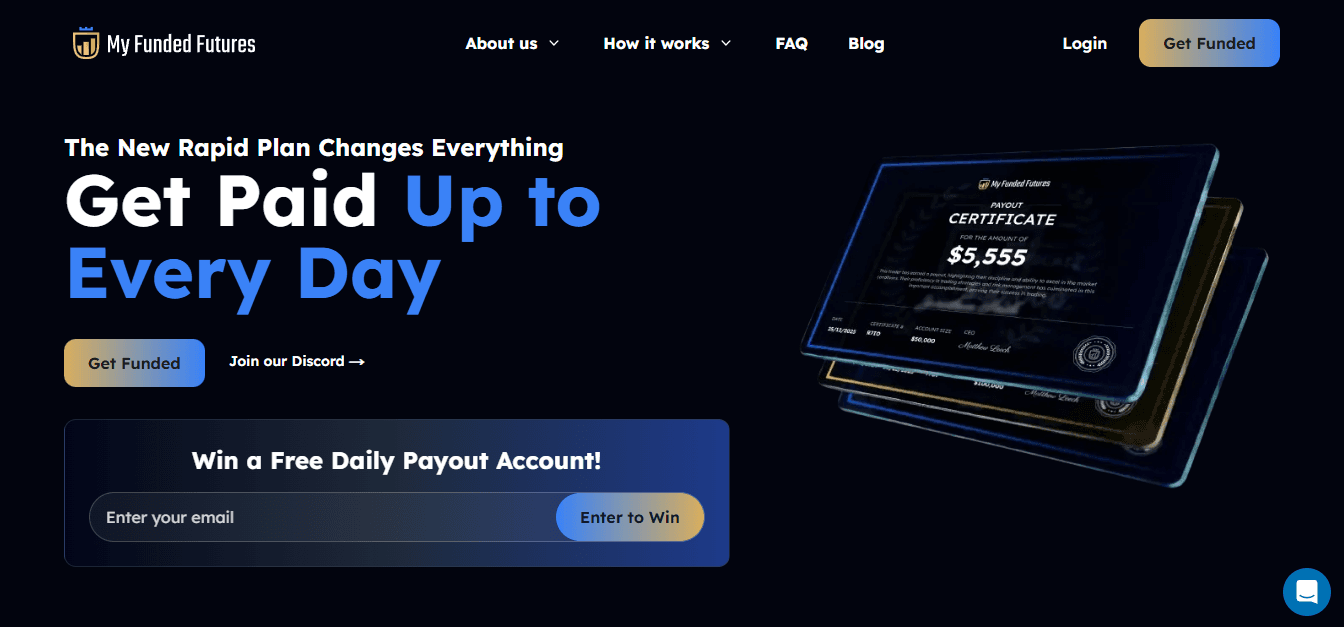
This American-based proprietary trading company provides an accessible gateway for new futures traders seeking budget-friendly options. Established a couple of years ago, it emphasizes straightforward evaluation processes and supportive tools that help rookies navigate the markets without overwhelming complexity or high upfront expenses.
Key Features
- Based in the United States, ensuring reliable regulatory alignment and operational stability.
- Operational for two years, offering a fresh yet proven approach tailored to beginner needs.
- Specializes in futures trading, ideal for those focusing on this asset class from the start.
- Compatible with multiple platforms, including Volbook, Tradovate, Quantower, and ATAS Orderflow Trading, plus four others for flexible trading setups.
- The maximum capital allocation is $450,000, providing room for growth as skills improve.
3. Tradeify

A newcomer to the US market, this firm caters to aspiring futures traders by keeping costs low and rules simple, making it a solid pick for those just starting out. With only a year in business, it focuses on user-friendly features that reduce the learning curve and financial strain for entry-level participants.
Key Features
- Located in the United States, providing accessible support and compliance for American traders.
- In operation for one year, bringing innovative, beginner-oriented strategies to the table.
- Dedicated to futures assets, perfect for novices honing in on this specific market area.
- Supports platforms such as Tradovate, NinjaTrader, TradingView, and Quantower to accommodate diverse trading preferences.
- Offers up to $750,000 in maximum funding, supporting progression from small to larger accounts.
4. Alpha Futures
Based in the United Kingdom, this prop firm is designed for cost-conscious beginners, offering discounted entry points and basic structures that avoid unnecessary complications. Launched recently, it prioritizes affordability and ease, helping new traders build experience without breaking the bank.
Key Features
- Operated from Great Britain, adding a global perspective with stable practices.
- Active for one year, focusing on streamlined services suited to starter levels.
- Concentrates on futures instruments, enabling targeted practice for inexperienced traders.
- Works with Tradovate, NinjaTrader, and TradingView platforms for straightforward access.
- Provides up to $450,000 in allocations, enabling gradual scaling for beginners.
5. Apex Trader Funding

An established US firm with a track record of supporting novice futures traders through deeply discounted evaluations and extensive resources. With five years under its belt, it balances affordability with comprehensive features that guide beginners toward successful funding at low cost.
Key Features
- Headquartered in the United States, ensuring trustworthy and regulated operations.
- Five years in business, delivering experienced yet approachable services for new entrants.
- Exclusively handles futures trading, allowing focused development for beginner traders.
- Integrates with numerous platforms, including Jigsaw Daytradr, Finamark, Tradovate, and 11 others, for versatile use.
- Impressive maximum funding up to $6 million, offering substantial growth potential.
6. FundedNext Futures

This emerging prop company from the United Arab Emirates targets budget-minded beginners in futures trading by minimizing initial outlays and simplifying requirements. As a very new entrant, it brings modern, low-cost models that appeal to those entering the field with limited funds.
Key Features
- Based in the UAE, providing an international flavor with efficient processes.
- Recently launched with no years listed, emphasizing innovative, entry-level-friendly tactics.
- Focused on futures assets, suitable for beginners specializing in this domain.
- Compatible with Tradovate, NinjaTrader, and TradingView for easy integration.
- Max capital allocation of $700,000, supporting step-by-step advancement.
7. Top One Futures
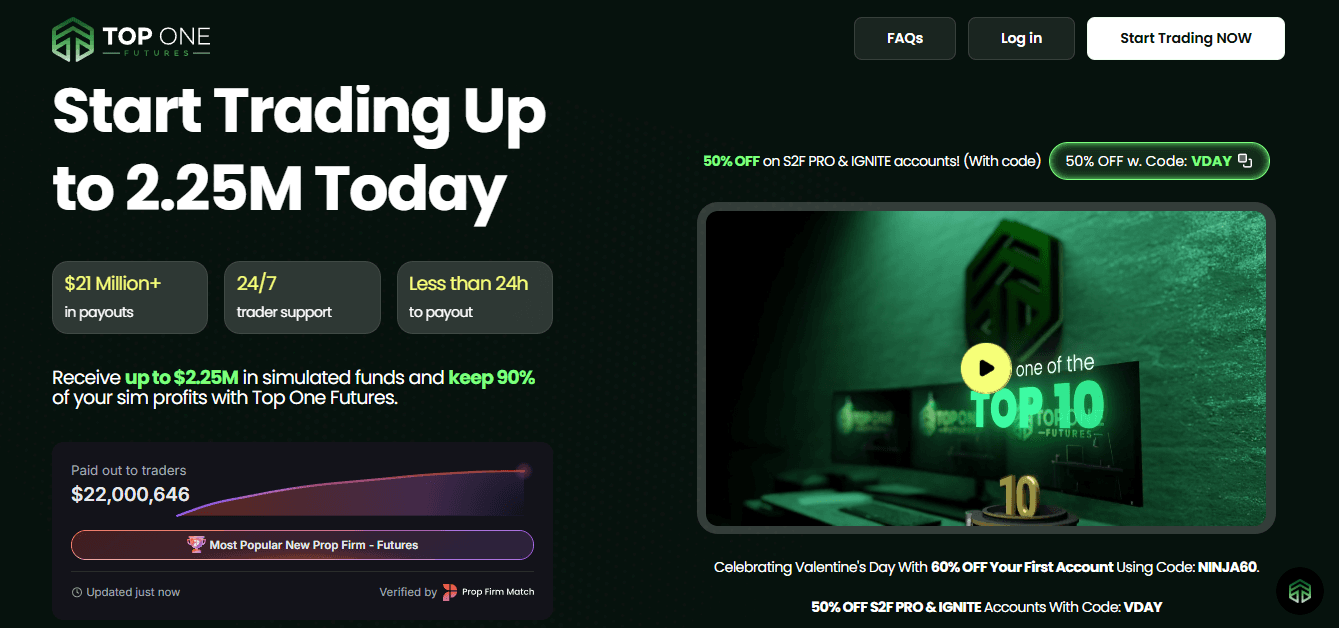
This US-based proprietary trading provider offers an attractive, low-cost entry point for newcomers to futures markets in 2026. As a recently established firm, it offers straightforward evaluation paths, strong scalability, and promotional incentives that ease the financial burden for those building their trading foundation.
Key Features
- Operated from the United States, promoting dependable support and adherence to familiar standards.
- New on the market with zero years of listed operation, yet gaining traction through modern, beginner-accessible designs.
- Exclusively geared toward futures contracts, enabling focused skill-building without distractions.
- Integrates smoothly with Tradovate, NinjaTrader, and TradingView for intuitive platform choices.
- Highest maximum funding allocation at $1.8 million, creating clear pathways for long-term account expansion.
8. Topstep

A veteran American firm renowned for its educational emphasis and structured approach, Topstep remains a top recommendation for beginners entering futures prop trading. With over a decade of experience, it offers reliable processes, helpful resources, and affordable entry points that help inexperienced traders develop discipline and consistency.
Key Features
- Headquartered in the US, backed by long-standing operational integrity and a strong reputation.
- More than 10 years in the industry, providing seasoned guidance and proven systems ideal for learning.
- Solely dedicated to futures trading, with built-in coaching to aid new participants.
- Features its proprietary TopstepX platform, designed for streamlined and educational use.
- Up to $750,000 in maximum capital access, supporting measured growth as proficiency increases.
How to Choose a Cheap Futures Prop Firm to Start Your Trading Career

Launching a career in futures trading often begins with joining a proprietary trading firm that offers funded accounts at low costs. Selecting an affordable option allows beginners to access significant capital without risking their personal funds, while focusing on skill development.
Evaluate Overall Costs Beyond the Initial Fee
When searching for a budget-friendly futures prop firm, look past the headline price of the evaluation challenge. True affordability includes any recurring subscriptions, reset charges, activation fees, and potential hidden expenses that can add up quickly for new traders. Many low-cost firms structure their pricing with one-time payments for challenges or monthly options, but the best value comes from those that eliminate activation fees and offer discounts. For instance, AquaFutures offers highly competitive monthly plans starting at $26 for a $25K account in its beginner tier, with no activation fees and frequent promotions such as 60% off, making it an accessible entry point for those starting out.
Assess Profit Sharing and Payout Reliability
A generous profit split and a reliable withdrawal process are crucial to turning your trading efforts into real income. Prioritize firms that offer high trading percentages and process payments promptly, with minimal delays or denials. Reliable payouts build confidence, especially for beginners building a career. Look for evidence of consistent rewards through trader testimonials and payout proofs. AquaFutures stands out by allowing traders to keep 100% of the first $15,000 in profits, with 90% thereafter, and processing weekly withdrawals within 24 hours—or an extra $500 bonus if delayed—ensuring quick access to earnings.
Examine Trading Rules and Risk Parameters
Trading guidelines, such as drawdown limits and position sizes, directly impact your ability to trade comfortably and succeed. Affordable firms should provide reasonable rules that support realistic strategies without overly restrictive conditions that lead to frequent failures. Flexible drawdowns, like end-of-day calculations rather than intraday trailing, and no strict consistency requirements, help reduce pressure. Many budget options include unlimited trading days and clear max contract limits. AquaFutures offers plans with no profit targets in certain one-step challenges, end-of-day or trailing drawdowns tailored to account sizes, and no time limits, creating a supportive environment for developing consistent habits.
Check Company Reputation and Trader Support
The firm's track record and level of assistance play a key role in long-term success. Review independent feedback, payout histories, and responsiveness to ensure the company is trustworthy and committed to trader growth. Strong reputations often correlate with better experiences, including access to educational resources and responsive help desks. Affordable yet reputable firms typically have high ratings from thousands of users. AquaFutures earns praise for its 24/7 support, transparent operations, and high satisfaction scores, helping newcomers navigate challenges effectively.
Consider Platform Compatibility and Account Scaling
Supported trading platforms and growth opportunities determine how well the firm fits your style and future ambitions. Choose ones with reliable software for futures execution and paths to larger capital allocations. Good, affordable firms integrate popular platforms and allow scaling based on performance. This supports career progression without switching providers frequently. AquaFutures provides access to advanced platforms such as ProjectX and Volumetrica, with account sizes scaling up to $450K, enabling traders to scale as their skills improve. Ready to begin your futures trading journey with an affordable, trader-focused prop firm? Explore AquaFutures' low-cost monthly or one-time challenges, generous splits, and instant funding options to get started today.
Unlock up to 50% off Your First Funded Account for Futures Trading
When you're scanning lists of affordable futures prop firms, the worry isn't just about low costs. It's about whether those low costs come with impossible evaluations, slow payouts, or rules that make it harder to build confidence as you scale. Many budget options come with hidden fees, restrictive policies, or support that disappears when you need it. AquaFutures removes those headaches entirely. You get fast access to funded futures accounts with instant options that let you skip lengthy challenges if you prefer, jumping straight into trading with real capital. The rules stay simple enough that you can focus on consistency instead of navigating bureaucratic hoops, and scaling happens as you prove yourself through steady performance, not arbitrary restrictions that cap your growth.
Thousands of traders already rely on AquaFutures for transparent terms, responsive support available around the clock, and payouts that actually arrive when promised. Whether you're testing new strategies or building toward larger positions over the months, the setup remains straightforward and is designed around what traders need. Ready to move forward? Explore account options today and get funded without the usual friction. Right now, you can unlock up to 50% off your first funded account, plus rotating BOGO deals and fresh bonuses updated weekly.
Related Reading
- Prop Firm Swing Trading
- Best Prop Firms for Stocks
- Prop Firms That Use MT5
- No Minimum Trading Days Prop Firm
- Prop Firms With Instant Funding
- One Phase Prop Firm
- Proprietary Trading Firms
- Best Funded Accounts UK
- Best Prop Firm in the World
- Cheapest Forex Funded Account
- Best Prop Firms That Allow EA
- Best UK Prop Firm
- Forex Prop Firms Accepting US Clients
- Best Forex Funded Prop Firms
- Best Funded Account Forex in UAE
