



9 Trusted Australian Prop Firms You Should Know
This guide cuts through the noise to help you identify reputable prop firms operating in Australia, so you can move forward with confidence and clarity about which opportunity suits you best.

Picture this: you're ready to trade futures, you've honed your strategy, but your capital is limited. Australian prop firms offer a solution by providing traders with funded accounts, giving you access to substantial trading capital without risking your own money. What is a funded account, and how can you find the right Australian proprietary trading firm that aligns with your approach, risk tolerance, and financial ambitions? This guide cuts through the noise to help you identify reputable prop firms operating in Australia, so you can move forward with confidence and clarity about which opportunity suits you best.
When you're evaluating your options, understanding the structure and benefits of funded accounts becomes essential to your decision. AquaFutures provides funded accounts for futures trading, offering the capital and support you need to execute your strategies while keeping more of your profits. Their approach focuses on transparent evaluation processes and trader-friendly terms, making it easier for you to focus on what matters: consistent, disciplined trading that aligns with your goals.
Summary
- Prop firms operate legally in Australia because they trade exclusively with their own capital and do not manage client investments, thereby avoiding regulatory triggers that require an Australian Financial Services License. They position themselves as skills assessment providers where traders pay evaluation fees to access challenges, not investment opportunities, keeping their operations outside ASIC's direct oversight while still accepting Australian participants without geographic restrictions.
- Most modern prop firms use performance-based assessments in which traders must meet 8-10% profit targets while staying within strict risk boundaries, including maximum daily losses of around 5% and overall drawdown caps of around 10%. According to Spotware, 90% of traders fail prop firm challenges, a statistic that reflects how difficult it is to maintain discipline under pressure rather than the quality of trading strategies, as the evaluation structure deliberately surfaces whether traders can follow a plan when capital constraints and profit targets create emotional tension.
- ASIC enforces a 30:1 leverage cap on retail forex accounts for major currency pairs to protect inexperienced traders from catastrophic losses, but these restrictions simultaneously limit profit potential for disciplined operators who understand position sizing and risk management. Prop firms operating in simulated trading environments or offshore structures sidestep these constraints, offering traders access to 50:1, 100:1, or higher leverage because they trade the firm's capital under its risk-management rules rather than operate retail accounts subject to local leverage limits.
- Traders operating within defined risk parameters show 40% better long-term consistency than those trading without external constraints, according to Forbes Business Council research published in January 2024. The discipline prop firms enforce through daily loss limits and maximum drawdown caps teaches traders to operate like institutions, exposing flaws in trading processes that small personal accounts hide and forcing sharper decision-making because the consequences of sloppy execution become immediately real.
- Prop firm profits are taxable income in Australia, and the ATO treats trading gains as either business income or capital gains depending on the frequency and intent of the trading. Traders must keep detailed records of all trades, payouts, and expenses, with evaluation fees potentially deductible as business expenses if trading with the intent to generate income, while currency conversions add complexity when firms pay in cryptocurrency or U.S. dollars, since each payout constitutes a taxable event requiring conversion to Australian dollars using exchange rates at the time of receipt.
- AquaFutures provides funded accounts for futures trading with instant funding options that skip lengthy evaluations, 24-hour payout guarantees that credit traders $500 if withdrawals are delayed, and a profit structure where traders keep 100% of the first $15,000 earned, then 90% beyond that, addressing the payout delays and complex restrictions many traders face with slower offshore alternatives.
What is a Prop Firm, and How Does It Work?

A prop firm supplies you with trading capital instead of requiring you to risk your own money. You trade using the firm's funds, demonstrate profitability within defined risk parameters, and keep a significant share of the profits you generate. The firm absorbs the downside risk beyond your evaluation fee, while you focus on executing your strategy with substantially more buying power than your personal account might allow. This model differs sharply from traditional brokerage relationships. When you open a retail account, you deposit your own capital, accept full liability for losses, and keep all profits (minus commissions). Prop firms invert that structure. They provide the capital, set strict risk limits to protect their exposure, and take a percentage of your gains in exchange for removing your personal financial risk.
How the Evaluation Process Works
Most modern prop firms use a performance-based assessment to identify disciplined traders before granting funded accounts. You pay a one-time evaluation fee, typically ranging from $100 to $500, depending on the account size you're targeting. This fee grants access to a simulated trading environment that mirrors live market conditions. During the evaluation, you must meet a profit target (typically 8-10% of the account balance) while staying within strict risk parameters. Common limits include a maximum daily loss of approximately 5% and an overall drawdown cap of approximately 10%. These constraints exist to filter out reckless trading and reward consistency over aggressive speculation.
Evaluation formats vary. One-step challenges require a single profitable trading phase. Two-step models add a verification phase to confirm you can replicate initial results without luck or excessive risk. Instant funding options skip the evaluation entirely but charge higher fees and impose tighter ongoing risk rules. 90% of traders fail prop firm challenges. That statistic reflects how difficult it is to maintain discipline under pressure, not necessarily the quality of strategies. The evaluation structure deliberately surfaces whether you can follow a plan when capital constraints and profit targets create emotional tension.
What Happens After You Pass
Successful completion grants access to a funded account, typically ranging from $25,000 to $250,000 or more. You execute real trades (or simulated trades with real payouts, depending on the firm's model), and profits are split between you and the firm. Most prop firms offer 80-90% profit shares to traders, though some structures vary based on account size or performance tier. If your losses exceed the predefined limits, the account will terminate. You are not liable for any fees beyond your initial evaluation fee. This structure protects both parties. The firm caps its risk exposure, and you avoid the financial ruin that can accompany overleveraged personal trading. The key difference from traditional employment lies in autonomy. You're not an employee receiving a salary. You're an independent trader using the firm's capital under agreed terms. You choose your strategies, manage your own schedule, and scale income based purely on performance.
Why Prop Firms Operate This Way
Prop firms profit from two revenue streams. Evaluation fees generate income from the majority of participants who don't pass. Profit splits from successful traders create ongoing revenue tied to genuine skill. This dual model allows firms to scale without hiring large teams or managing complex payroll structures.
The evaluation fee isn't a scam when the firm genuinely funds successful traders and pays out consistently. It's a filter. Traders who lack discipline, risk management, or a tested strategy reveal themselves quickly under evaluation constraints. Those who pass demonstrate they can generate returns within boundaries that protect capital.
Some firms use fully simulated environments, paying traders from fee revenue rather than actual market profits. Others deploy real capital and hedge positions across their trader base. The distinction matters less than the firm's payout reliability and transparency. A trader who receives consistent, timely payouts cares more about that dependability than whether the firm's backend uses live or simulated execution.
What This Means for Your Trading
Prop firms lower the barrier to trading larger positions without depleting personal savings. If you've developed a profitable strategy but lack capital to scale it, a funded account lets you prove your edge with someone else's money. The downside stays contained. Lose the account, and you're out the evaluation fee, not your life savings. Risk management becomes non-negotiable. Prop firm rules force discipline that many traders skip when using personal funds. Daily loss limits and drawdown caps prevent the emotional spiral that turns a bad day into a catastrophic week. These constraints may seem restrictive at first, but they mirror the risk controls under which institutional traders operate. Learning to trade profitably within boundaries makes you better, not limited.
The model rewards consistency over home runs. Firms don't want traders chasing massive gains that risk blowing their accounts. They want steady, repeatable performance that compounds over time. That aligns with long-term trading success far better than chasing lottery-ticket trades. But the structure also demands you understand what you're signing up for. Not all prop firms operate with the same integrity, and the difference between a firm that genuinely supports trader success and one that profits primarily from evaluation fees becomes clear only after you engage. That's where the next decision point emerges, and it's more nuanced than most traders expect.
Related Reading
- What Is a Funded Account
- Does Ftmo Offer Instant Funding
- How to Get a Funded Trading Account
- No Challenge Prop Firm
- Funding Traders Rules
- What Is a Prop Firm Account
- Synthetic Funded Account
- What is a Funded Firm
- One Step Prop Firm Challenge
- Trading Challenges
- Instant Funding Rules
- Prop Firm Ip Address Rule
- Halal Prop Firms
- Top 10 Prop Firms 2025
- Cheapest Futures Prop Firm
- No Activation Fee Prop Firm
- Prop Firms In Usa
- Prop Firms That Allow Trade Copiers
- Best Prop Trading Firms
- Forex Prop Firms With Instant Funding
- Best Prop Firms For Forex
- Best Prop Firm To Start
- Best Instant Funded Prop Firm
- Best Prop Firms in UAE
Why Choose a Prop Firm for Trading in Australia?

Australian traders turn to prop firms because they remove the single biggest barrier to scaling a proven strategy: personal capital. If you've spent months refining an approach that works on a small account, you face a frustrating bottleneck. Compounding 5% monthly returns on $5,000 feels slow. Prop firms let you apply that same strategy to $100,000 or more without liquidating savings or taking on debt.
The appeal isn't just about account size. It's about separating your trading performance from your personal financial survival. When you trade your own money, every losing day threatens your rent, your confidence, and your ability to stay in the game. That emotional weight distorts decision-making. You exit winners early to lock in relief. You hold onto losers too long because admitting the loss feels unbearable. Prop firms absorb that psychological burden. The capital isn't yours, so losses sting less. The evaluation fee caps your downside, and everything beyond that becomes someone else's problem.
Australia's trading landscape makes this model particularly relevant. The Australian Securities and Investments Commission (ASIC) enforces strict leverage limits on retail forex accounts, capping exposure at 30:1 for major currency pairs. According to a 2023 Finance Magnates interview with ASIC representatives, these restrictions aim to protect retail traders from catastrophic losses while limiting profit potential for disciplined operators. Prop firms operating under simulated or offshore structures sidestep these constraints, allowing traders to access higher leverage and larger positions without violating local retail trading rules.
Access to Capital Without Personal Risk
Most traders never reach their potential because they can't afford to. You might generate consistent 3-4% monthly returns, but if you're working with $10,000, that's $300-$400 before tax. It's not enough to quit your job. It's barely enough to justify the hours spent analyzing charts. Prop firms flip that equation. Pass an evaluation, and you're suddenly managing $50,000, $100,000, or more. That same 3% monthly return becomes $1,500 to $3,000. Your skill level hasn't changed. Your strategy hasn't changed. Only the capital base shifted, and with it, your income potential. The risk profile improves, too. When you trade personal funds, a string of bad trades can wipe out months of progress. Rebuilding a blown account from savings takes time you might not have. Prop firms cap your loss at the evaluation fee. Blow the account, and you're out $200 or $300, not $10,000. That difference matters when you're learning to handle larger positions and the emotional pressure that comes with them.
Structured Risk Management That Builds Discipline
Prop firm rules feel restrictive until you realize they're teaching you to trade like an institution. Daily loss limits force you to stop when emotions run high. Maximum drawdown caps prevent the revenge trading that turns a bad week into a career-ending month. These aren't arbitrary obstacles. They're the same risk controls that banks and hedge funds use to protect capital.
The structure exposes flaws in your process that small accounts hide. When you're trading $2,000, a 10% drawdown feels manageable. You tell yourself you'll recover. When you're managing $100,000 and a 10% loss means termination, every trade decision sharpens. You stop taking marginal setups. You respect stop losses. You plan position sizes with precision because the consequences of sloppiness just become real.
According to Forbes Business Council research published in January 2024, traders operating within defined risk parameters show 40% better long-term consistency than those trading without external constraints. The discipline prop firms enforce isn't punishment. It's training. You're learning to manage capital the way professionals do, and that skill transfers whether you stay with the firm or eventually trade independently again.
Scalability and Performance-Based Growth
Prop firms reward consistency with account growth. Start with a $50,000 funded account, trade profitably for three months, and many firms will scale you to $100,000 or $150,000. Your profit split often improves as you prove reliability. This progression model aligns incentives. The firm wants you to succeed because your profits become their profits. You're not fighting against the house. You're both betting on your skill.
This scalability matters in Australia's time zone. Sydney sits in a unique position, overlapping with the Asian market opening and catching the tail end of U.S. sessions. Traders who can capitalize on volatility during these windows benefit from having larger accounts to deploy across multiple instruments. A $25,000 account might limit you to one or two positions. A $200,000 account lets you spread risk across forex, indices, and commodities simultaneously, smoothing equity curves and reducing exposure to any single market's whims.
The flexibility extends to trading style. Some prop firms cater to day traders. Others accommodate swing traders holding positions for days or weeks. Instant funding models let you start trading immediately without evaluation delays, though they typically impose tighter risk controls. Two-step evaluations give you more room to demonstrate your edge over time. You choose the structure that fits your approach, not the other way around.
Diverse Market Access Across Asset Classes
Australian retail traders often face limitations on what they can trade and how much leverage they can use. Prop firms expand that universe. You gain access to U.S. equity indices, European forex pairs, cryptocurrency futures, and commodity markets that might be cost-prohibitive or restricted under retail brokerage terms. This breadth lets you adapt to changing market conditions. When forex volatility dries up, you can shift focus to indices. When commodities trend, you can allocate more capital there. Diversification across asset classes reduces dependence on any single market's performance, smoothing your income and reducing the risk of prolonged drawdowns.
For traders in Australia, where the domestic equity market accounts for a small share of global volume, this international exposure matters. You're not limited to ASX-listed stocks or AUD-based pairs. You can trade the S&P 500, NASDAQ, gold, oil, Bitcoin futures, and dozens of forex pairs from a single funded account. That access, combined with the capital to deploy meaningful position sizes, transforms what's possible compared to a self-funded retail setup.
Most traders handle capital constraints by staying small, trading conservatively, and hoping to compound slowly over the years. As account sizes grow and opportunity costs mount, that patience wears thin. Firms like AquaFutures centralize capital access and payout infrastructure, compressing the timeline from evaluation to funded trading while maintaining transparent profit splits and weekly payout schedules that remove the uncertainty many traders face with slower, less reliable alternatives. But access to capital and favorable terms only matter if the firm operates within legal boundaries and honors its commitments. That's where the regulatory landscape becomes more complex than most traders expect.
Are Prop Firms Legal in Australia?

Yes, prop firms operate legally in Australia. No federal or state legislation prohibits them from offering funded trading programs to Australian residents. The Australian Securities and Investments Commission (ASIC) oversees financial services, but most prop firms structure their operations to fall outside the scope of activities requiring an Australian Financial Services License (AFSL). They provide evaluation services and profit-sharing arrangements rather than managing client investments or offering financial advice, keeping them in a regulatory gray zone that permits operations without direct oversight.
This legal standing exists because prop firms trade exclusively with their own capital. Traders pay an upfront evaluation fee to access a challenge, not to deposit funds for the firm to invest. If you pass, you trade the firm's money under agreed risk parameters and receive a share of profits. That structure avoids the regulatory triggers that govern brokers, fund managers, or financial advisors. You're not a client. You're a performance-based contractor sharing in the gains you generate.
How Prop Firms Avoid Regulatory Triggers
ASIC requires an AFSL for businesses that provide financial product advice, deal in financial products on behalf of clients, or operate managed investment schemes. Prop firms sidestep these categories by positioning themselves as skills assessment providers. The evaluation fee purchases access to a trading challenge, not an investment opportunity. The firm doesn't promise returns. It doesn't manage your money. It tests whether you can trade profitably while adhering to defined risk limits.
Most international prop firms base their operations offshore in jurisdictions such as the Seychelles, St. Vincent and the Grenadines, or the British Virgin Islands. These locations offer lighter regulatory frameworks and lower compliance costs. By operating outside Australia, firms avoid ASIC's direct jurisdiction while still accepting Australian traders. This offshore structure is legal as long as the firm doesn't engage in activities that require local licensing, such as soliciting retail investments or providing personalized financial advice.
Some Australian-based prop firms do operate domestically. If they offer services that cross into regulated territory, like providing leveraged trading accounts that resemble retail CFD products, they may need an AFSL. But firms that stick to evaluation-based models and profit splits typically remain outside ASIC's regulatory perimeter. The distinction hinges on whether the firm is facilitating your trading or managing capital on your behalf.
Why ASIC's Leverage Caps Don't Apply
ASIC enforces a 30:1 leverage cap on retail forex accounts for major currency pairs. These restrictions aim to protect inexperienced traders from catastrophic losses, but they also limit profit potential for skilled operators who understand position sizing and risk management. Prop firms operating in simulated trading environments or offshore structures are not subject to these retail leverage limits. You can access 50:1, 100:1, or higher leverage depending on the firm's terms, because you're not trading a retail account. You're trading the firm's capital under its risk management rules. This difference matters for Australian traders who've outgrown the constraints of retail accounts. If your strategy requires larger position sizes or tighter stop-losses that require more leverage to maintain acceptable risk-reward ratios, prop firms offer a legal pathway to trade as institutions do. The firm absorbs the regulatory burden, and you benefit from the flexibility.
Consumer Protections Still Apply
Just because prop firms avoid AFSL requirements doesn't mean they operate in a legal vacuum. Australian Consumer Law continues to govern their interactions with local traders. Firms must provide clear terms, avoid misleading advertising, and honor contractual obligations. If a prop firm promises payouts and then refuses to release funds without legitimate cause, you have recourse under consumer protection statutes. The challenge lies in enforcement. If an offshore firm violates its terms, pursuing legal action across jurisdictions becomes expensive and time-consuming. That's why reputation matters more than regulatory status when choosing a firm. A prop firm with a track record of consistent payouts, transparent rules, and responsive support offers more practical protection than regulatory oversight that's difficult to enforce internationally.
Tax Obligations for Australian Traders
Profits from funded accounts are taxable income in Australia. The Australian Taxation Office (ATO) treats trading gains as either business income or capital gains, depending on your trading frequency and intent. If you trade regularly with the goal of generating income, your profits likely qualify as business income subject to standard income tax rates. Occasional trades held for longer periods might qualify for capital gains treatment, which offers a 50% discount if you hold positions for more than 12 months.
Keep detailed records of all trades, payouts, and expenses. Evaluation fees may be deductible as business expenses if you're trading with the intent to generate income. Software subscriptions, data feeds, and internet costs directly related to trading can also reduce taxable income. The ATO expects accurate reporting, and failing to declare trading income invites audits and penalties.
Some prop firms pay in cryptocurrency or U.S. dollars. Currency conversions add complexity to tax reporting. You'll need to convert payouts to Australian dollars using the exchange rates in effect at the time of receipt. If the firm pays in crypto, each payout constitutes a taxable event, and you'll owe tax on the AUD value at the time of receipt. Holding crypto afterward creates additional capital gains or losses when you eventually convert to fiat.
What Happens If a Firm Shuts Down
Prop firms aren't banks. They don't hold customer deposits, and ASIC doesn't insure their operations. If a firm collapses or exits the market, you have no government-backed protection for outstanding payouts or evaluation fees. That risk is real. The prop trading industry has seen firms disappear after collecting evaluation fees from thousands of traders, leaving funded accounts unpaid and support channels silent.
This vulnerability makes due diligence essential. Check how long the firm has operated. Look for consistent payout evidence on forums, social media, and review sites. Avoid firms that delay payouts, impose unexplained restrictions, or change terms retroactively. A firm that has reliably paid traders for two or three years has demonstrated operational stability. A firm that launched six months ago with aggressive marketing and vague payout terms carries a higher risk.
Traders who prioritize speed and reliability often gravitate toward firms that guarantee payout timelines. Some firms promise withdrawals within 24 hours or compensate traders for delays. This commitment signals operational maturity and financial stability. Firms like AquaFutures offer a 24-hour payout guarantee: if they miss the deadline, they add $500 to your account, reducing the uncertainty many traders face when waiting days or weeks for offshore firms to process withdrawals. Weekly payout schedules with no fixed calendar dates further reduce friction, allowing you to access earnings as soon as you meet profit targets rather than waiting for arbitrary processing windows.
The Real Risk Isn't Legal, It's Operational
Prop firms are legal in Australia, but legality doesn't guarantee trustworthiness. The industry attracts both legitimate operators and opportunists who profit from evaluation fees without genuinely funding successful traders. Your risk isn't a regulatory shutdown. It's choosing a firm that won't honor its commitments. That's why the next decision matters more than the legal framework surrounding it. Knowing that prop firms are legal doesn't tell you which ones deserve your evaluation fee or your time. The firms worth your attention share specific traits that separate them from the noise, and those distinctions become obvious once you know what to look for.
9 Trusted Australian Prop Firms You Should Know

Nine firms stand out to Australian traders for their transparent rules, verified payout histories, and flexible evaluation structures that accommodate different trading styles. These platforms operate internationally but welcome Australian participants without geographic restrictions, offering access to futures, forex, indices, commodities, and cryptocurrencies with profit splits ranging from 80% to 100%. What separates them from the dozens of alternatives flooding social media ads is operational consistency. They've processed thousands of payouts, maintained clear communication during platform issues, and avoided the sudden rule changes that plague newer entrants.
The firms below represent different approaches to funding. Some prioritize instant access. Others emphasize multi-step evaluations that verify consistency. A few specialize in specific markets, such as futures or forex, while others provide broad asset coverage. Your choice depends on whether you value speed over flexibility, prefer tight daily loss limits or wider drawdown tolerance, and whether you're willing to trade evaluation complexity for better profit splits.
1. AquaFutures

AquaFutures specializes in providing quick access to simulated capital for futures market participants, enabling them to manage positions without personal financial risk. With a strong emphasis on rewarding performance through substantial profit sharing and streamlined evaluation processes, it caters to a global audience, including Australian users, by offering flexible programs that align with diverse strategies across currency exchange, benchmarks, precious metals, digital assets, and derivatives. Backed by positive feedback and rapid reward distributions, it positions itself as a reliable choice for advancing trading careers in a supportive simulated environment.
Key Features
- Provides access to forex pairs, market indices, metals, cryptocurrencies, and futures contracts.
- Operates accounts primarily in US dollars, though specifics are implied through standard practices.
- Features no explicit refund on initial fees, focusing instead on value through performance incentives.
- Allows scaling of funded balances up to $450,000 based on equity growth and consistent results.
- Does not specify allowances for duplicating trades, prioritizing individual strategy execution.
- Welcomes participants from various countries worldwide, with no noted restrictions for Australia.
- Offers promotional deals, such as the current 60% discount, available for a limited time.
- Includes unlimited trading durations without time pressures on most programs.
- Delivers a high profit split starting at 100% on the first $15,000 earned, then 90% thereafter.
- Ensures 24/7 customer support across multiple channels to resolve issues promptly.
Why Traders Choose AquaFutures
Market enthusiasts often choose this platform for its emphasis on instant funding options that bypass lengthy delays, making it ideal for Australian traders seeking efficient entry into prop trading environments without excessive hurdles. The guarantee of retaining full profits initially, combined with swift weekly payouts and a commitment to no hidden charges, builds trust and encourages long-term engagement. High satisfaction scores from thousands of verified users highlight its reliability, fast support, and charitable initiatives, such as environmental efforts, which resonate with those valuing ethical operations alongside competitive trading conditions in futures and related assets.
2. FTMO

This firm built its reputation on professional trading conditions and realistic evaluation objectives. The two-step challenge format verifies you can replicate initial results without luck or excessive risk. The first phase requires hitting an 8% profit target while maintaining a 10% maximum drawdown and a 5% daily loss limit. The second phase reduces the profit target to 5% while maintaining the same risk parameters. Pass both, and you can access accounts ranging from $10,000 to $200,000 with an 80% profit split, scaling to 90% after consistent performance.
The platform refunds your challenge fee with your first payout, effectively making the evaluation free if you succeed. That structure aligns incentives. The firm profits when you profit, not just from assessment fees. FTMO provides advanced charting tools, economic calendars, and performance analytics that mirror institutional setups. You're not just getting capital. You're getting infrastructure that supports serious trading.
Asset coverage includes forex, indices, commodities, stocks, and cryptocurrencies. The firm operates globally with no restrictions for Australian traders. Frequent promotional offers reduce entry costs, though the real draw is operational stability. FTMO has processed payouts reliably since 2015, building trust through consistency rather than aggressive marketing. Educational resources on risk management, psychology, and technical analysis position the firm as a development partner rather than just a capital provider.
3. OneFunded

Simplicity defines this platform. One evaluation phase, straightforward rules, and fast access to funded accounts. You hit a profit target while staying within drawdown limits, then start trading live capital. The 25% discount with code MYFB25 makes entry affordable, and the firm refunds your assessment fee on your first withdrawal, reducing the financial barrier if you succeed.
The platform covers cryptocurrencies, forex, stocks, indices, commodities, and metals. Accounts operate in USD, and the firm supports copy trading where applicable, letting you replicate strategies across multiple accounts if your approach scales. Scaling opportunities grow your virtual funds as you demonstrate consistent results, though specifics depend on your performance tier. With a 4.9 rating from six reviews, the sample size is small, but feedback highlights responsive support and clear communication. The firm welcomes Australian traders without geographic barriers, and the evaluation structure accommodates diverse strategies. If you prefer minimal bureaucracy and direct paths to funding, this setup removes unnecessary complexity.
4. FunderPro

Instant funding sits at the core here. Skip the evaluation entirely, pay a higher entry fee, and start trading immediately with access to simulated capital. The trade-off is tighter ongoing risk controls. Daily loss limits and drawdown caps stay strict to protect the firm's exposure, but you avoid the weeks spent proving consistency in a challenging environment.
The platform covers cryptocurrencies, currency trading, benchmarks, and raw resources. Accounts are denominated in U.S. dollars, and the firm allows strategy replication under defined rules. Scaling supports capital increases into the millions for traders who maintain profitability over time. The 10% discount with MYFB10 reduces upfront costs, though instant funding fees remain higher than those in traditional evaluation models. With a perfect 5.0 rating from one review, the data is limited, but the firm's emphasis on speed appeals to experienced traders confident in their systems. If you've already proven your edge elsewhere and want immediate deployment, this removes the waiting period that delays income generation.
5. FundedFirm

Forex specialists find value here. The platform focuses on currency pairs, cryptos, indicators, commodities, energies, and metals, with infrastructure optimized for tight spreads and fast execution. Two-step evaluations verify consistency, and the firm refunds assessment fees after successful funding. Profit splits start at 80% and scale to 100% as you prove reliability over multiple payout cycles.
The 6% discount using MYFB6 is modest, but the firm's 4.7 rating from 16 reviews reflects consistent experiences with rapid disbursements and expert guidance. Copy trading is permitted under the rules, and scaling plans gradually increase your account size. The firm operates in USD and welcomes Australian participants without restrictions. Educational support includes webinars, strategy breakdowns, and risk management frameworks. The firm positions itself as a development partner, not just a capital source. If you're refining your forex approach and want feedback alongside funding, this setup provides both.
6. SabioTrade
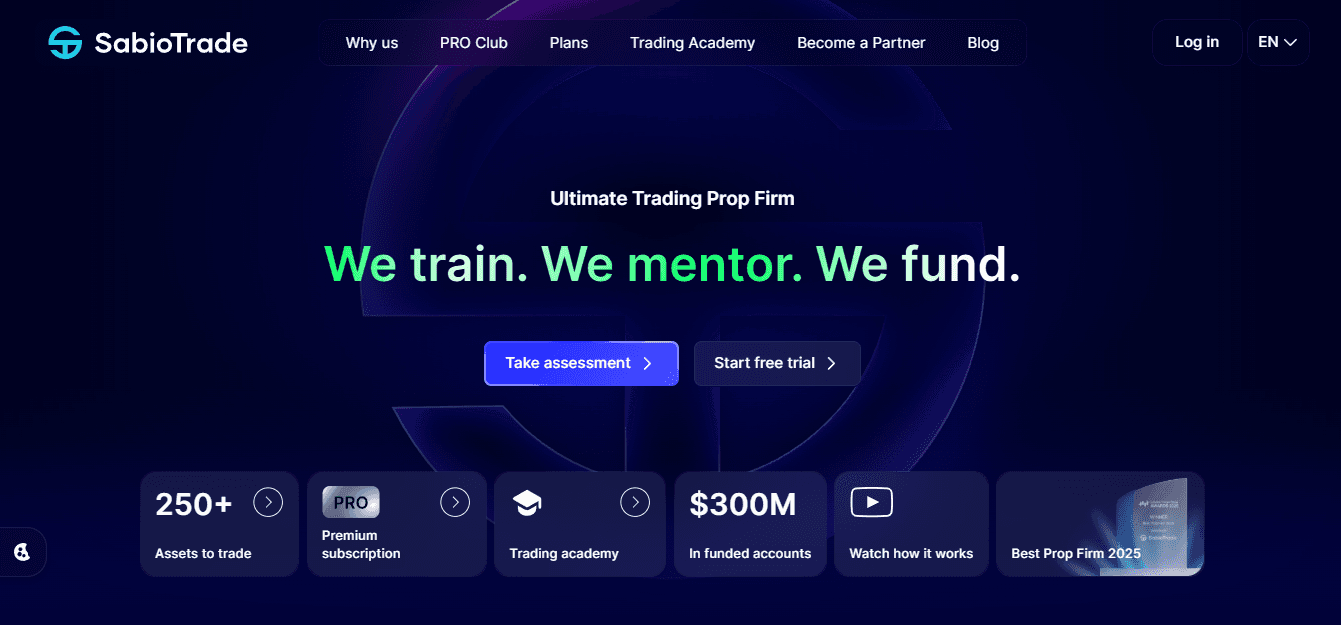
Disciplined risk management defines this firm's culture. Evaluation targets emphasize consistent performance over aggressive gains. You're not chasing 20% monthly returns. You're proving you can generate steady profits without violating strict loss limits. That focus attracts traders who've learned the hard way that survival matters more than home runs.
The platform trades cryptocurrencies, forex pairs, indices, and commodities. Accounts are denominated in US dollars, and the firm offers fee refunds for select programs. Scaling plans reward proven track records, and copy trading features are permitted where applicable. Promotional discounts reduce entry costs for new sign-ups. Strong user ratings highlight transparency and support quality. The firm provides mentorship elements, including trade reviews and strategy consultations, positioning itself as a long-term partner rather than a transactional service. If you value structure and feedback over pure capital access, this approach builds sustainable habits.
7. Funded Trading Plus

Flexibility drives this platform's appeal. No consistency rules means you can swing trade, scalp, or hold positions overnight without worrying about arbitrary profit distribution requirements. The firm removes many restrictive policies that force traders into specific styles, letting your strategy dictate your approach rather than the firm's risk preferences.
The platform covers forex, indices, commodities, and select other assets. Accounts are denominated in USD, and refunds are available upon successful funding. Scaling grows account sizes with performance, and copy trading is permitted in compliant setups. Periodic promotions reduce entry costs, though the real value lies in the no-time-limit challenges that remove artificial pressure. High marks for flexibility make this attractive to traders whose strategies don't fit traditional evaluation constraints. If you've struggled with consistency rules elsewhere, this setup accommodates diverse approaches without penalizing your style.
8. The5ers

Longevity matters in prop trading. Firms that survive multiple market cycles prove operational resilience. This platform has operated since 2016, using innovative funding models like hyper-growth programs that reward steady progress with aggressive scaling. You start small, prove consistency, and watch your capital allocation multiply as you hit performance milestones. The firm focuses primarily on forex, with some indices and metals available. Accounts operate in USD, and fee refunds or credits apply in certain paths. Scaling plans push traders toward higher capital levels faster than traditional models, though risk controls remain strict. Copy trading is supported under specific guidelines.
Educational resources include strategy libraries, market analysis, and psychology frameworks. The firm's emphasis on realistic objectives and reliable payouts builds trust among traders tired of firms that promise the moon but delay withdrawals. If you want long-term capital growth without excessive pressure, this model balances ambition with sustainability.
9. Funding Pips

Speed and simplicity define this modern platform. Fast evaluations, generous profit splits, and minimal restrictions appeal to traders who value efficiency. The firm supports forex, crypto, indices, commodities, and metals, with USD accounts and refund mechanisms in successful cases. Scaling enables growth through consistent results, and copy trading features are permitted.
Discount codes reduce customer acquisition costs, and the firm is praised for its competitive pricing and user experience. With a focus on quick payouts and straightforward rules, this setup removes friction points that slow progress elsewhere. If you want to move from evaluation to funded trading without bureaucratic delays, this platform prioritizes speed. Most traders select a firm based on surface-level features such as profit splits or account sizes, only to discover the real differences after they've paid evaluation fees and started trading. The traits that determine whether you'll actually receive payouts and scale your account are revealed through operational details that most marketing pages gloss over.
Related Reading
- Best Funded Prop Firms
- Prop Firms That Use TradingView
- 1 Phase Prop Firm
- No Consistency Rule Prop Firm
- Prop Firms That Use Tradelocker
- Prop Firm Comparison
- How Do Prop Firms Work
- Regulated Prop Firms
- Prop Challenge
- The Cheapest Prop Firm
- Trading With Borrowed Capital
- Top Tradig Prop Firms
- Top Prop Company
- US-based Prop Firms
- Top 10 Prop Firms In The World
- Forex Prop Firms In The Us
- Best Prop Firm Forex
How to Choose the Right Prop Trading Firm as a Trader in Australia

Selecting a prop firm in Australia requires evaluating operational reliability over marketing promises. The firms that consistently pay traders, maintain transparent rules, and scale accounts without arbitrary restrictions share specific traits that only become apparent through detailed examination of fee structures, platform capabilities, and support responsiveness. Your choice determines whether you'll spend months navigating payout delays and hidden restrictions or immediately focus on trading profitably with capital that actually arrives when promised. The decision extends beyond profit splits and account sizes. Firms differentiate themselves through payout speed, platform stability during volatile sessions, and whether they impose consistency rules that conflict with your strategy. A firm offering 90% profit splits means nothing if withdrawals take weeks or support vanishes when you need position limit clarifications during active trades.
Operational Transparency and Payout Reliability
The clearest signal of a trustworthy firm is how it handles withdrawals. Firms confident in their infrastructure guarantee specific payout timelines and attach penalties to delays. This accountability distinguishes operators who genuinely fund traders from those who profit primarily from evaluation fees. When a firm promises payouts within 24 hours and compensates you $500 for missed deadlines, they're signaling operational maturity and financial stability that newer entrants can't match.
Weekly payout schedules without fixed calendar dates further reduce friction. You access earnings as soon as you hit profit targets rather than waiting for arbitrary monthly processing windows. This flexibility matters when you're managing cash flow or reinvesting profits into larger challenges. Firms that batch payouts monthly often do so to manage liquidity constraints, not to accommodate trader convenience.
Verification matters more than testimonials. Search for payout evidence on independent forums, Reddit threads, and Trustpilot reviews from traders who've received multiple withdrawals over several months. A single positive review from a new account carries less weight than consistent positive experiences from hundreds of verified traders. Look for specifics: payout amounts, processing times, and how the firm handled disputes or technical issues.
Fee Structure and Hidden Costs
Upfront evaluation fees represent your risk cap, but ongoing costs determine long-term profitability. Some firms charge monthly platform fees, inactivity penalties, or data subscription costs that erode returns. Others impose withdrawal fees that reduce your effective profit split. Calculate total costs across a six-month period, assuming regular trading and monthly payouts to understand the real expense.
Australian traders benefit from firms using one-time assessment fees rather than recurring subscriptions. This structure eliminates the pressure to trade continuously just to justify monthly costs. You can step away during low-volatility periods without burning capital on platform access you're not using. Single-payment models also simplify tax reporting since you're not tracking monthly deductions against trading income.
Refund policies matter when evaluating fee fairness. Firms that return your challenge fee with your first payout effectively make the assessment free if you succeed. This aligns incentives. The firm profits when you profit, not just from assessment revenue. Avoid firms that charge separate fees for scaling, platform upgrades, or accessing specific markets. These incremental costs compound quickly.
Platform Compatibility and Execution Quality
Trading infrastructure directly impacts your ability to execute strategies without technical interference. Verify the firm supports platforms you already use. Switching from MetaTrader to a proprietary system introduces learning curves that slow your progress and increase mistakes during the critical early weeks of funded trading. If you rely on custom indicators or automated strategies, confirm full compatibility before paying evaluation fees.
Execution speed becomes critical during high-volatility sessions when Sydney overlaps with Asian market opens or U.S. news releases create rapid price movements. Slippage, requotes, or platform freezes during these windows destroy edge. Test the platform during a trial period, if available, or scrutinize reviews that specifically mention execution quality under volatile conditions. Traders focused on scalping or news trading need millisecond-level responsiveness that some simulated environments can't provide.
For algorithmic traders, API access and expert advisor support are non-negotiable. Some firms restrict automated trading or impose limits on trade frequency that conflict with high-frequency strategies. Clarify these constraints upfront. A firm advertising "no restrictions" should specify whether that includes algorithmic execution, copy trading across multiple accounts, or holding positions through weekend gaps.
Profit Split Progression and Scaling Terms
Initial profit splits grab attention, but scaling terms determine long-term income potential. A firm offering 80% splits that scales you to $200,000 after three profitable months outperforms a 90% split firm that caps accounts at $50,000 regardless of performance. Evaluate the full progression path, including how quickly you can scale, what performance metrics trigger increases, and whether profit splits improve with account size.
Some firms increase your split from 80% to 90% or even 100% after consistent profitability. Others maintain fixed percentages but aggressively grow account sizes. The optimal structure depends on your trading style. Consistent, conservative traders benefit more from aggressive scaling. Volatile traders with occasional large wins prefer higher initial splits since scaling opportunities may take longer to materialize.
Understand the mechanics of profit calculations. Do they measure profits from the initial balance or the high-water mark? Can you withdraw freely or only after hitting specific thresholds? Some firms require you to maintain minimum balances before accessing earnings, effectively locking capital until you reach higher profit levels. This constraint limits cash-flow flexibility and forces you to leave more capital at risk within the firm's ecosystem.
Risk Parameter Alignment with Your Strategy
Daily loss limits and maximum drawdown caps must accommodate your strategy's natural volatility. A scalper executing 50 trades daily with tight stops needs different parameters than a swing trader holding positions for days with wider stops. If your average losing day approaches 3% due to position sizing and market conditions, a 2% daily loss limit will terminate your account during normal operations, not because you're reckless, but because the rules don't fit your approach.
Trailing drawdown versus static drawdown changes how you manage risk. Trailing drawdown resets as your account grows, giving you more room as profits accumulate. Static drawdown measures from your starting balance, maintaining consistent risk limits regardless of gains. Trailing structures favor aggressive traders who can quickly build cushions. Static limits suit conservative approaches where steady, smaller gains compound without large swings. Some firms prohibit trading during news events or restrict holding positions through market closures. These rules protect the firm but constrain strategies that capitalize on volatility spikes or overnight gaps. If your edge depends on trading central bank announcements or capturing Asian-session momentum that extends into European opens, verify that the firm allows this before committing.
Traders often choose firms based on advertised features, only to discover operational friction after funding. The firms that remove barriers rather than create them share a philosophy that speed and transparency matter more than complex rules designed to protect the firm at your expense. Platforms like AquaFutures compress the timeline from evaluation to funded trading while maintaining 24-hour payout guarantees and 100% profit retention on initial earnings, addressing the exact friction points that slow progress and erode trust elsewhere.
Support Responsiveness During Critical Moments
Quality support becomes essential when you need position limit clarifications during active trades or encounter platform issues during volatile sessions. Firms that offer 24/7 availability across multiple channels (live chat, email, Discord, phone) demonstrate a commitment to trader success. Single-channel support or business-hours-only availability leaves you stranded when problems arise outside standard hours, which is particularly problematic for Australian traders operating across global time zones.
Response speed matters as much as availability. A support team that resolves technical issues within minutes prevents small problems from becoming account-ending losses. When you're locked out during a position that's moving against you, or the platform freezes during a news spike, every minute counts. Reviews highlighting specific support interactions (not generic praise) reveal how firms handle pressure situations.
Educational resources and community access add value beyond capital provision. Firms offering trade reviews, strategy consultations, or active Discord communities position themselves as development partners. This support structure helps you refine your approach, learn from other funded traders, and avoid common mistakes that lead to account violations. The difference between a firm that wants you to succeed and one that profits from your failure becomes obvious in how they invest in trader education.
Geographic and Regulatory Considerations
While most prop firms operate offshore, some maintain Australian entities or partner with ASIC-regulated brokers for execution. This local presence doesn't guarantee better service, but it can simplify tax reporting and provide clearer legal recourse if disputes arise. Firms transparent about their corporate structure, leadership team, and operational locations signal legitimacy that fully anonymous operators can't match.
Currency considerations affect your returns when firms pay in USD or crypto. Exchange rate fluctuations increase income volatility, and conversion fees reduce the effective profit split. Some firms offer AUD-denominated accounts or multi-currency payout options that let you manage exposure. If you're trading primarily during Sydney hours and covering expenses in Australian dollars, minimizing currency conversion friction improves cash flow predictability.
Tax implications vary based on how the firm structures payments. Some classify payouts as contractor income, others as profit-sharing distributions. This distinction affects your tax obligations and eligibility for deductions. Consult with an accountant familiar with prop trading income before committing to a firm, particularly if you're planning to scale to six-figure annual earnings where tax efficiency becomes material. But knowing what to look for only helps if you can afford to test multiple firms without depleting capital on evaluation fees.
Unlock up to 50% off Your First Funded Account for Futures Trading
Testing multiple firms to find one that actually pays becomes expensive when evaluation fees range from $200 to $500 per attempt. AquaFutures removes that barrier with instant funding options that skip lengthy evaluations, allowing you to start trading immediately if your strategy is ready. Their 24-hour payout guarantee means withdrawals arrive within a day, or they credit your account $500, eliminating the uncertainty that plagues traders waiting weeks for offshore firms to process requests.
The structure stays simple. You keep 100% of the first $15,000 you earn, then 90% of all amounts above that. Weekly payouts arrive without fixed calendar dates, so you access earnings as soon as you hit profit targets rather than waiting for arbitrary processing windows. Accounts scale to $450,000 based on consistent performance, and 24/7 support responds within minutes when you need position limit clarifications or encounter technical issues during volatile sessions. Thousands of traders trust AquaFutures because the firm delivers what it promises without hidden restrictions that surface only after you've paid evaluation fees.
Ready to trade with real capital instead of spending months navigating payout delays and complex rules? Visit AquaFutures to explore account options and get funded today. Use code VALENTINE to unlock up to 60% off your first funded account, plus access to surprise BOGO deals and weekly bonuses that accelerate your path to consistent trading income.
Related Reading
- Prop Firm Swing Trading
- Best Prop Firms for Stocks
- Prop Firms That Use MT5
- No Minimum Trading Days Prop Firm
- Prop Firms With Instant Funding
- One Phase Prop Firm
- Proprietary Trading Firms
- Best Funded Accounts UK
- Best Prop Firm in the World
- Cheapest Forex Funded Account
- Best Prop Firms That Allow EA
- Best UK Prop Firm
- Forex Prop Firms Accepting US Clients
- Best Forex Funded Prop Firms
- Best Funded Account Forex in UAE
