



10 Futures Trading Chart Patterns Every Trader Should Know
Futures trading patterns made clear: learn 10 chart patterns traders use to read trends, breakouts, and reversals. Start here.
.webp)
You're staring at a futures chart, watching price bars dance across your screen, but you can't quite tell if that formation signals a breakout or a trap. Understanding futures trading patterns is essential for anyone searching for the best futures trading platform for beginners, because recognizing chart formations such as head-and-shoulders, triangles, and flags separates profitable traders from those who guess. This article will show you how to spot key futures chart patterns effortlessly, make sharper trades, and boost profits with proven setups that professional traders rely on daily.
That knowledge becomes even more powerful when you have the right resources behind you. AquaFutures offers funded accounts for futures trading that give you the capital and support to practice these pattern recognition skills in real market conditions without risking your own money. When you can identify continuation patterns, reversal formations, and consolidation zones while trading with a funded account, you gain the confidence to execute your strategy and refine your approach based on actual market behavior rather than theory alone.
Table of Contents
- What Are Futures Trading Chart Patterns, and How Do They Work?
- How Reliable Are Futures Trading Chart Patterns?
- Can Beginners Use Futures Trading Patterns Successfully?
- 10 Futures Trading Chart Patterns Every Trader Should Know
- How to Identify Futures Trading Patterns Accurately
- How AquaFutures Supports Futures Traders Using Chart Patterns
- Unlock up to 50% off Your First Funded Account for Futures Trading
Summary
- Chart patterns function as visual probability frameworks that reveal shifts in control between buyers and sellers at specific price levels. Their reliability depends on volume confirmation, trend alignment, and clean formation structure rather than subjective interpretation. According to statistical analysis from NinjaTrader, head-and-shoulders patterns achieve approximately a 60% success rate, but that figure climbs significantly when volume expansion and trend context support the setup.
- Beginners succeed with futures patterns by following structured setups rather than chasing intuition or forcing trades without confirmation. Research shows that 70% of traders lose money, but the cause is behavioral errors such as ignoring volume signals, oversizing positions, and entering incomplete formations, rather than pattern failure itself. Traders who apply strict entry criteria, position sizing rules, and confirmation requirements from day one avoid the traps that create those statistics.
- Volume separates conviction from noise across all chart patterns and timeframes. Breakouts accompanied by expanding volume prove institutional money backs the move, not just speculative positioning or algorithmic activity. Low-volume breakouts lack follow-through because large participants haven't committed capital, leaving retail traders exposed to reversals that trap premature entries.
- Context determines everything when evaluating the reliability of patterns in futures markets. The strength of the preceding trend directly impacts whether formations resolve successfully, because exhausted moves create the fuel for reversals or continuations. A double bottom forming after a sustained downtrend in crude oil futures signals genuine exhaustion, while the same pattern appearing mid-range in sideways action often fails.
- Multi-timeframe alignment amplifies pattern reliability by capturing institutional order flow and filtering random fluctuations that plague shorter intervals. Patterns that coincide with major support and resistance zones or economic events resolve more decisively because they align with levels where large participants already have orders waiting, creating the momentum needed for follow-through.
Proper capital allocation transforms pattern knowledge from theoretical understanding into executable strategy without the constraints that force traders to skip optimal setups or exit prematurely. Funded accounts for futures trading address this by providing professional capital allocations that allow traders to size positions according to pattern structure and natural volatility rather than personal account limitations.
What Are Futures Trading Chart Patterns, and How Do They Work?

Chart patterns are price formations that appear when traders react similarly under comparable market conditions. They work by revealing shifts in control between buyers and sellers at specific price levels. When you spot a double bottom forming after a sharp decline in crude oil futures, you're watching buyers repeatedly defend a support zone, signaling potential reversal momentum. These recurring structures help you anticipate whether the price will continue trending, reverse direction, or consolidate before breaking out.
Why Pattern Recognition Matters for Funded Account Success
The difference between hitting your profit target and blowing past your drawdown limit often comes down to reading price behavior correctly. When you trade a funded account, you're working within specific risk parameters. Missing a head and shoulders reversal in the Nasdaq futures can cost you three percent of your account in a single session. Recognizing that same pattern early lets you position for the move, capture the momentum, and stay well within your risk guidelines while building consistent returns.
How Buyers and Sellers Create Recognizable Structures
Price doesn't move randomly. It reflects the ongoing negotiation between buyers willing to pay higher prices and sellers demanding better exits. When buyers step in aggressively at $4,200 in S&P 500 futures three times over two weeks, that support level becomes visible on your chart. When sellers repeatedly reject $4,350, that resistance zone defines the upper boundary. Chart patterns form when these zones interact with momentum, creating triangles, flags, wedges, and channels that telegraph the next probable move.
Volume Confirms What Price Suggests
A breakout without volume is a warning sign, not an opportunity. Strong institutional participation manifests as increased volume during the breakout phase. Over 20 distinct chart patterns appear regularly across futures markets, but the reliable ones share one trait: volume expansion at the decision point. When gold futures break above a symmetrical triangle on light volume, the price often reverses back into the pattern within hours. When that same breakout happens on triple the average volume, follow-through becomes far more likely because larger players are committing capital.
Timeframes Determine Pattern Reliability
A bullish flag on a five-minute chart in crude oil futures might resolve in 30 minutes. That same pattern on a daily chart could take weeks to complete and produce a significantly larger move. Higher timeframes filter out noise and reflect broader market participation. Professional traders align their entries by reading daily or four-hour patterns for directional bias, then dropping to shorter timeframes for precise entry points. This approach reduces false signals and increases the probability that your trade aligns with the dominant momentum.
Converting Pattern Recognition into Scalable Performance Capital
Mastering these patterns becomes exponentially more valuable when you're trading with funded accounts for futures trading that provide the capital to execute your setups without risking personal funds. Pattern recognition isn't just theoretical knowledge. It's the skill that lets you consistently hit the six percent profit targets required to unlock larger account sizes, weekly payouts, and profit splits that reward precision rather than luck. But knowing the patterns exist doesn't answer the question that determines whether you actually use them in live markets.
How Reliable Are Futures Trading Chart Patterns?

Chart patterns function as probability frameworks, not certainty machines. Their reliability hinges on whether volume confirms the breakout, whether the broader trend supports the direction, and whether the pattern formed cleanly without distortion. A head-and-shoulders reversal in the E-mini S&P 500, backed by surging volume and aligned with major resistance, carries far more weight than the same shape appearing in choppy, low-volume conditions.
Why Context Determines Everything
The strength of the preceding trend directly affects pattern reliability because exhausted moves provide fuel for reversals or continuations. A double bottom that forms after a sustained downtrend in crude oil futures signals genuine exhaustion, while the same pattern appearing mid-range in sideways action often fails. Clean structures with defined boundaries outperform ambiguous shapes because they reflect clear agreement between buyers and sellers at specific price levels. When external news overrides technical setups, or liquidity dries up during off-hours, even textbook formations collapse without warning.
Volume Separates Conviction From Noise
Breakouts accompanied by expanding volume prove real money backs the move, not just speculative positioning or algorithmic noise. According to NinjaTrader's statistical analysis of trading patterns, head-and-shoulders patterns have a success rate of approximately 60%, but that figure rises significantly when volume confirmation and trend alignment are present. Low-volume breakouts lack follow-through because institutional participants haven't committed, leaving retail traders exposed to reversals that trap eager entries. Consistent volume analysis transforms pattern recognition from subjective interpretation into evidence-based decision-making.
Timeframe Alignment Amplifies Reliability
Higher timeframes capture institutional order flow and filter out the random fluctuations that plague shorter intervals. A triangle breakout on the daily chart in Nasdaq futures carries more weight than the same pattern on a five-minute chart because it represents sustained conviction across multiple sessions. Patterns that align with major support and resistance zones or economic events resolve more decisively because they coincide with levels where large participants already have orders waiting. Volatile contracts like natural gas demand extra caution, while trending markets enhance continuation patterns by providing directional momentum.
Risk Management Protects Against Inevitable Failures
Proper stop placement just beyond pattern boundaries limits damage when setups fail, preserving capital for the next high-probability trade. Position sizing calibrated to the distance between entry and stop keeps risk consistent, whether trading a tight flag in gold futures or a wide head-and-shoulders in treasury bonds. This discipline ensures that even a string of losses doesn't devastate the account, allowing the statistical edge to compound over time.
Traders who chase every formation without filters encounter repeated failures that erode both capital and confidence, turning pattern recognition into a source of frustration rather than advantage. But knowing when patterns work doesn't answer whether someone new to futures can actually execute them without years of screen time.
Related Reading
- Best Futures Trading Platform for Beginners
- Is Trading A Good Career
- Why Trade Futures Instead Of Options
- Is Futures Trading Gambling
- How To Start Futures Trading
- What Is Leverage in Futures Trading
- What Is Crypto Futures Trading
- How To Become A Professional Trader
Can Beginners Use Futures Trading Patterns Successfully?

Beginners succeed with futures trading patterns by following structured setups rather than chasing intuition. The edge exists in the formations themselves, not in years of screen time. What separates profitable beginners from those who quit after three months isn't talent or market feel. It's the willingness to trust probability over emotion and execute the same high-success-rate patterns repeatedly with disciplined risk controls.
The Myth That Keeps New Traders Sidelined
The common belief claims beginners need years of experience before attempting pattern-based futures trading. This assumption ignores how patterns function as visual probability tools rooted in measurable order, not in mystical chart reading. When someone new to futures learns to identify a double bottom with volume expansion at support, they access the same statistical edge as a veteran who spots the identical formation. The pattern doesn't care about the trader's resume.
NinjaTrader's statistical analysis confirms that 70% of traders lose money, but the research reveals the cause isn't pattern failure. Losses stem from forcing trades without confirmation, ignoring volume signals, and risking too much capital per setup. Beginners who apply strict entry criteria and position-sizing rules from day one avoid the behavioral traps that lead to those statistics.
Why Most Beginners Actually Fail
The real problem arises when new traders treat patterns as subjective guesses rather than as probabilistic frameworks with defined parameters. A head-and-shoulders reversal in crude oil futures either forms correctly, with declining volume on the right shoulder and expansion on the breakdown, or it doesn't. Beginners who skip confirmation steps and enter based on incomplete formations create self-fulfilling losses that reinforce the myth that patterns don't work for inexperienced traders.
After watching lakh-level fluctuations within minutes during high-stakes trading, many beginners experience the stress and anxiety that comes from position sizes far too large for their capital base. The burnout is real. Trading futures with oversized lot sizes transforms pattern recognition into a source of panic rather than advantage, making it nearly impossible to execute setups with the calm precision required for statistical edges to compound.
The Structured Path That Works
Start with one high-probability pattern on daily or four-hour futures charts to build recognition skills without cognitive overload. Combine each formation with volume confirmation and alignment with the broader trend to transform subjective chart reading into mechanical execution. Practice on six months of historical data first, marking every valid setup and noting which confirmation signals preceded successful breakouts versus false moves.
When transitioning to live markets, size positions so that each trade risks exactly 1% of total capital. Place stops just beyond pattern boundaries to exit mechanically when setups invalidate. This discipline protects beginners through the inevitable drawdowns while the statistical advantage compounds across dozens of trades.
Leveraging Statistical Expectancy Through Disciplined Pattern Execution
Thomas Bulkowski’s exhaustive research, which analyzed thousands of chart patterns across decades of market data, demonstrates that select reversal patterns reach their projected targets 70% or more of the time when formed correctly and confirmed. This success holds for traders who apply the statistics consistently, showing that beginners gain the same edge as veterans by respecting the numbers rather than relying on gut feel.
Focus exclusively on liquid contracts during active sessions to reduce slippage and improve fill quality. Review every trade against the original pattern criteria within 24 hours, identifying personal execution weaknesses rather than blaming the formation. Over three to six months of deliberate practice, pattern recognition becomes intuitive and delivers repeatable positive expectancy without requiring a decade of market experience.
10 Futures Trading Chart Patterns Every Trader Should Know

Prioritizing patterns by frequency, clarity, and reliability accelerates skill development compared to trying to master every formation simultaneously. The ten patterns below appear across all futures markets and timeframes, offering distinct setups for entries, exits, and risk management. Mastering these formations builds the pattern recognition needed to hit consistent profit targets in both live accounts and funded trading programs.
1. Double Tops and Fake Breakouts
Double tops form when the price reaches a resistance level twice and fails to break through, signaling weakening bullish momentum and a potential bearish reversal. In futures markets, this pattern highlights exhaustion after an uptrend, as sellers aggressively defend the same price zone. Traders watch for the breakdown below the trough between the two peaks as confirmation, which often leads to a measured decline equal to the pattern's height.
Waiting for a decisive break below support increases the success rate by avoiding premature entries on fakeouts. One bad entry after another destroys confidence and quickly drains trading capital, particularly when traders assume a level will hold without watching for volume confirmation or aggressive selling. Place protective stops above the recent highs to limit exposure if the market instead breaks upward. This disciplined approach turns the double top into a reliable signal for short positions in contracts like crude oil or stock index futures during overextended rallies.
2. V Tops and V Bottoms
V tops appear as sharp, sudden reversals from a strong uptrend into a steep decline, driven by rapid shifts in sentiment or news events. These spikes create dramatic price peaks with little consolidation, making them challenging to trade without additional context. Fundamentals play a crucial role here, as the pattern often coincides with overbought conditions or unexpected negative catalysts in futures.
V bottoms mirror this action at market lows, showing swift recoveries from panic selling. Because they offer limited structure for confirmation, traders combine them with volume spikes or support levels for better timing. Double tops and bottoms provide clearer signals in most cases, but V formations reward those who act quickly on strong momentum shifts when the setup aligns with broader market context.
3. Head and Shoulders
The head-and-shoulders pattern develops over three peaks, with the middle peak (head) exceeding the two surrounding shoulders, indicating a progressive loss of upward momentum. This classic reversal setup in futures charts shows buyers failing on successive attempts to drive the price higher. The neckline connecting the lows between peaks serves as the critical support level whose breach confirms the shift to bearish control.
Even irregular or "ugly" formations perform well once the price closes below the neckline with conviction. Traders measure the projected target by subtracting the pattern height from the breakout point, offering clear profit objectives that align with the specific percentage gains required in funded account programs. Retests of the neckline often provide low-risk re-entry opportunities as the downtrend gains traction, allowing traders to add to winning positions without increasing initial risk.
4. Pennants
Pennants represent brief consolidations after strong directional moves, forming small symmetrical triangles that signal continuation of the prior trend. In futures trading, they emerge during pauses where traders reposition following powerful impulses in commodities or indices. The converging trendlines reflect decreasing volatility and building tension before the next leg.
Confirmation arrives with a strong breakout candle on expanding volume, propelling price in the original direction. Premature entries before this break frequently lead to losses from false moves that chop up accounts. The pattern's reliability increases as trends extend, delivering explosive follow-through once the pennant resolves with proper volume support.
5. Saucers (Cup and Handle)
Saucer or cup-and-handle patterns unfold gradually over weeks or months, showing a smooth rounding of the bottom, followed by a modest pullback in the handle. This structure captures a slow transition from selling pressure to accumulation, and eventually to bullish control, in futures markets. The handle represents a final shakeout before the uptrend resumes with conviction.
Volume typically dries up during the cup formation and picks up on the breakout above the handle's resistance. These longer-term setups often foreshadow sustained moves higher, especially in agricultural or energy futures. The pattern's depth and duration provide clues to the potential size of the subsequent advance, helping traders set realistic profit targets that compound over multiple trades.
6. Triangles
Triangles form during extended sideways consolidations where price action contracts between converging trendlines, reflecting a period of indecision and decreasing volatility in futures markets. Symmetrical triangles remain neutral until resolved, while ascending or descending variants hint at directional bias. The longer and tighter the triangle builds, the more explosive the eventual breakout tends to be as pent-up energy is released.
Traders wait for a decisive close outside the trendlines, accompanied by rising volume for confirmation. This breakout often produces strong momentum candles that propel the price in a new direction. In futures contracts, triangle resolutions frequently align with economic data releases or shifts in open interest, offering reliable continuation or reversal signals depending on the context and prior trend strength.
7. Flags
Flags appear as compact rectangular consolidations that tilt against the prevailing trend, creating the visual of a flag on a pole after a sharp price surge or drop. These continuation patterns frequently appear on intraday futures charts, where momentum pauses briefly before resuming. The counter-trend slope of the flag reflects temporary profit-taking or repositioning without invalidating the larger move.
Day traders and swing participants enter on the breakout in the direction of the original trend with volume support. Stops are placed on the flag's opposite side for tight risk control, keeping losses small relative to the potential measured move. Flags deliver high-probability setups in liquid markets like E-mini S&P or crude oil, where the measured move often equals the length of the preceding pole, providing clear risk-reward ratios that support consistent profitability.
8. Ross Hooks
Ross Hooks, named after trader Joe Ross, develops as a pullback immediately following a breakout that continues the dominant trend. These formations occur across all timeframes and futures instruments, offering frequent opportunities without complex structures. The hook represents a final test of the breakout level before price accelerates again in the primary direction.
Traders enter on the break of the hook high or low with confirmation from price action. This straightforward pattern rewards precision by exploiting natural market behavior following breakouts. Ross Hooks stand out for their reliability in day trading and swing trading, appearing repeatedly in trending futures markets and providing multiple chances to participate in the same directional move with defined risk.
9. Rectangles
Rectangles develop as clear trading ranges bounded by parallel support and resistance levels, showing balanced buying and selling pressure over time. Price oscillates between these horizontal boundaries until a breakout occurs in either direction. These patterns provide traders the flexibility to prepare orders on both sides of the range in futures contracts, allowing quick reaction regardless of which way the market resolves.
Breakouts from rectangles on increased volume signal the start of a new directional move with measurable targets based on the range height. Even imperfect rectangles with slight irregularities remain effective when traders wait for confirmation rather than anticipating the break. The pattern works especially well in range-bound environments ahead of major news events, where the eventual resolution often generates strong momentum that carries through multiple sessions.
10. Channels
Channels display steady, parallel trendlines that contain price action as it advances or declines in a controlled manner. These formations stand out for their symmetrical appearance and help traders visualize the current market slope. Once identified, channels serve multiple purposes, from mean-reversion trades to breakout strategies in futures.
Participants buy near the lower channel line and sell near the upper one in established trends, or prepare for powerful moves when the price escapes the channel. Channels prove valuable for setting dynamic stops and targets that adjust as the pattern extends. Their predictability in hindsight makes them essential for both trend-following and counter-trend approaches once the boundaries prove reliable through multiple touches.
Related Reading
- Futures Trading For Beginners
- Can You Day Trade Futures Without 25k
- Forex Vs Futures
- Stocks Vs Options Vs Futures
- Benefits Of Trading Futures
- Gold Futures Trading Strategy
- How Does Futures Trading Work
- Trading Gold Futures
- Day Trading Futures Strategies
- Futures Trading Basics
- Best Indicators For Futures Trading
- Futures Trading Guide
How to Identify Futures Trading Patterns Accurately
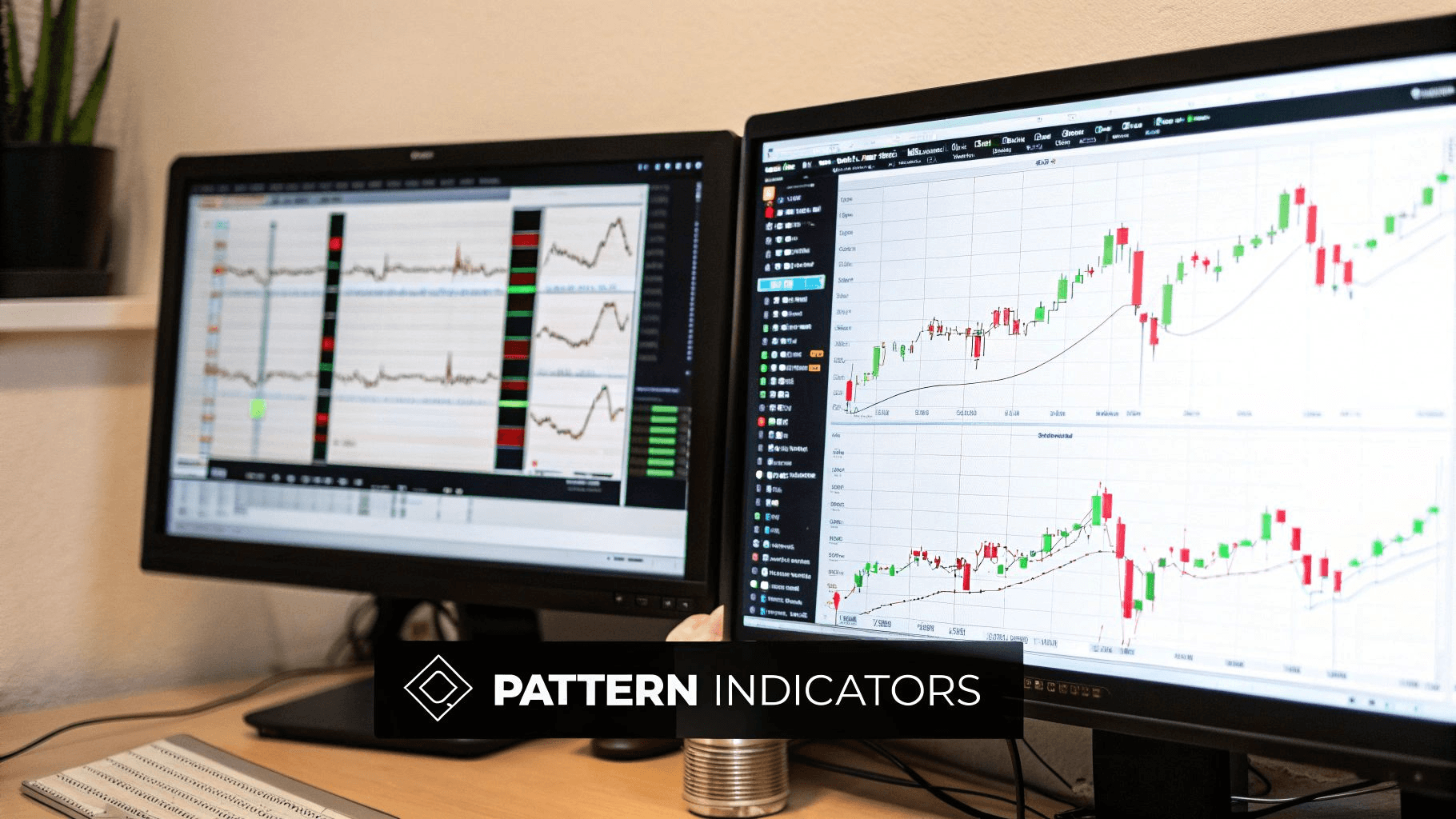
Recognition speed matters because funded traders face profit targets and drawdown limits that punish hesitation and reward precision. Accurate identification separates setups that meet a 6% profit threshold from formations that trap capital in sideways noise. The difference lies in applying structural rules before committing risk, not trusting gut feelings formed from incomplete information.
Establish the Preceding Trend First
Every reliable pattern requires context. Reversal formations need an established uptrend or downtrend to show exhaustion, while continuation patterns appear as pauses within that trend. Without this context, random consolidations get mistaken for meaningful setups. Scan higher timeframes to confirm the dominant direction before zooming in for pattern details, because a head and shoulders formation in a sideways market carries far less weight than one terminating a multi-week rally.
Draw Precise Trendlines and Boundaries
Connect swing highs and swing lows with clean trendlines to define support, resistance, and pattern boundaries. Use at least two points for initial lines and seek a third for validation. In futures charts, focus on closing prices or candle bodies rather than extreme wicks to reduce noise from temporary spikes. Accurate lines reveal the true shape and breakout zones, turning subjective guesses into measurable thresholds that either hold or break with conviction.
Analyze Volume for Confirmation
Volume validates pattern development and strengthens breakout signals. Rising volume during formation or on the decisive move shows genuine participation, while declining volume warns of weakness. According to e-futures.com, volume analysis distinguishes real conviction from low-liquidity traps, filtering out many false formations early. Compare volume against recent averages to separate institutional commitment from retail noise that evaporates at the first sign of resistance.
Check Multiple Timeframes for Alignment
Patterns gain reliability when they align across timeframes. A daily chart pattern gains power when the weekly structure supports the same direction. Lower timeframes provide precise entry timing, but higher ones reveal the bigger picture and institutional footprints. This multi-timeframe approach prevents trading against the larger market flow, ensuring your setup aligns with the directional bias that drives sustained moves rather than brief counter-trend bounces.
Wait for Breakout Confirmation
Never assume a pattern completes until price breaks the key boundary with conviction. Premature entries before the breakout lead to whipsaws and unnecessary losses. Look for strong candles and volume expansion on the break to confirm resolution. This patience turns potential setups into high-probability trades, especially when working within the strict risk parameters that funded accounts demand. Traders using funded accounts for futures trading find that confirmation-based entries compress drawdown periods and accelerate progress toward profit splits, because each trade carries higher conviction and tighter risk control.
Related Reading
- Futures Trading Tips
- Spot Trading Vs Futures Trading
- Best Coin For Futures Trading
- Futures Trading Risk Management
- Futures vs. CFD
- Futures Trading Patterns
- Best App For Futures Trading
- Best Crypto Futures Trading Platform
- Best Futures Trading Software
How AquaFutures Supports Futures Traders Using Chart Patterns

Spotting a clean double bottom or head-and-shoulders formation means nothing if you lack the capital to size positions properly, or if fear forces you out before the pattern completes. AquaFutures removes that friction by providing funded accounts ranging from $25,000 to $450,000, allowing traders to execute chart patterns with professional capital while bearing zero personal financial risk. The structure aligns profit incentives with disciplined pattern recognition: traders keep 100% of the first $15,000 in profits and 90% thereafter, with weekly payouts that reward accuracy and consistency rather than gambling or overtrading.
Capital That Matches Pattern Risk Parameters
Micro-sizing positions distort the edge. When you're forced to trade $4,200 support in S&P 500 futures with a $5,000 personal account, the natural stop placement below support becomes disproportionately large relative to your capital. You either skip the trade or accept catastrophic risk. AquaFutures accounts eliminate that constraint by providing capital allocations that allow proper position sizing relative to pattern structure. A breakout from a $4,350 resistance level with a $50 stop makes sense on a $100,000 account, but it's reckless on $5,000. Larger funded capital lets traders respect the pattern's natural volatility without forcing artificial compromises that sabotage execution.
Drawdown Rules That Support Pattern Completion
Many traders blow accounts not because their patterns fail, but because they exit during normal retest phases or consolidation. AquaFutures offers both end-of-day and trailing drawdown modes tailored to different account sizes, giving traders room to hold through the volatility that naturally surrounds breakouts and reversals. A head-and-shoulders pattern might retest the neckline before continuing lower. A double bottom often pulls back to support before rallying. These aren't failed trades; they're structural phases within the pattern. Flexible drawdown limits let traders manage positions through these moments without artificial pressure that forces premature exits.
Unlimited Time to Refine Pattern Recognition
Rushing to identify patterns because you're on a 30-day evaluation clock creates forced trades and emotional tilt. According to AquaFutures Trading Parameters, the platform offers unlimited trading periods in most programs, removing time pressure entirely. Traders refine recognition skills over weeks or months, wait for high-probability setups with full volume confirmation, and skip marginal formations without penalty. This environment builds the behavioral consistency that separates profitable pattern traders from those who chase every ambiguous setup, hoping to hit evaluation targets.
Isolating Execution Focus Through Structural Risk Assumption
Most traders know their edge works on paper. The psychological battle starts when trading matters, when real funded capital is involved, and losses feel personal even though they're not. AquaFutures assumes all drawdown risk, letting traders focus purely on pattern execution without the fear-driven early exits that destroy otherwise sound strategies.
Platforms like ProjectX and Volumetrica provide clean charts, fast execution, and volume data needed for precise pattern identification, while 24/7 support handles operational questions, allowing traders to maintain focus on market analysis. The structure rewards what actually matters:
- Accurate pattern recognition
- Disciplined entry timing
- Consistent risk management
Unlock up to 50% off Your First Funded Account for Futures Trading
You've learned the patterns. You've studied the volume signals, the neckline retests, and the breakout structures. But small accounts force you to skip the best setups, exit too early when support holds, or sit out entirely because risking your own money feels too heavy. Pattern knowledge without proper capital is like owning a map you can't afford to follow.
AquaFutures removes that barrier. Trade with firm capital up to $450,000, apply real position sizing to every double bottom or pennant breakout, and carry zero personal liability for losses. You keep 100% of your first $15,000 in profits, then 90% after, with weekly payouts and 24-hour guarantees. Flexible drawdown rules and unlimited time periods let you wait for clean, volume-confirmed setups without artificial pressure.
Professional platforms deliver the precision charting you need, while 24/7 support handles the rest. Stop leaving profits on the table because of capital limits. Join 190,000+ traders already scaling their strategies with funded futures trading accounts. Get funded today and turn the patterns you just studied into consistent, sizable rewards.
