



5 Best Micro Futures Brokers for Active Traders in 2026
Best micro futures broker for active traders? Review margin rates, fees, platforms, and Micro E-mini access before you open an account.

Futures margin requirements can make or break your trading strategy, especially when you're working with limited capital and need every dollar to count. Finding the right micro futures broker means understanding how margin works, what contract sizes fit your account, and which platform gives you the tools to trade futures without overextending your risk. This article breaks down the top options so you can make a clear, informed choice.
If you want to further stretch your trading potential, AquaFutures offers funded accounts for futures trading that let you trade with more capital than you currently have, without putting your own savings on the line. Instead of worrying about whether your account balance meets minimum margin requirements, you get access to real trading conditions through a funded model that supports active traders looking to grow.
Table of Contents
- What Are Micro Futures and How Do They Work?
- Why Do Traders Choose Micro Futures Over Standard Futures?
- Are Micro Futures Profitable for Beginners to Trade
- 5 Best Micro Futures Brokers for Active Traders in 2026How to Choose the Best Micro Futures Broker for Your Trading Style
- How to Choose the Best Micro Futures Broker for Your Trading Style
- Why AquaFutures Is an Alternative to the Best Micro Futures Brokers
- Unlock up to 50% off Your First Funded Account for Futures Trading
Summary
- The capital requirement gap between micro and standard futures contracts is greater than most traders initially realize. The Micro E-mini S&P 500 has a margin requirement of around $1,200, compared with roughly $12,000 for the standard ES contract, according to StoneX.
- Position-sizing precision is where micro futures offer their most practical advantage. A 20-point swing in the S&P 500 costs $100 on a Micro E-mini position versus $1,000 on a standard E-mini, according to Charles Schwab. That granularity allows traders to size positions according to actual risk rules rather than whatever the minimum contract size forces on them.
- The psychological cost of oversized contracts is a factor that most trading education underestimates. A 10-point adverse move on a standard ES contract costs $500 per contract, while the same move on an MES costs $50. The market did the same thing, and the chart looks identical, but one trader is managing stress while the other is thinking clearly.
- Beginners can start trading micro futures with as little as $500 to $1,000, according to Optimus Futures, which fundamentally changes the learning timeline. With day trade margins as low as $50 per micro contract at select brokers, a trader working a $2,000 account can run a multi-contract strategy and compound gains across sessions without the all-or-nothing exposure that standard contracts impose on undercapitalized accounts.
- The structure surrounding a trading strategy shapes outcomes just as much as the strategy itself. Traders with positive expectancy systems can still deplete accounts when position sizing relative to personal capital creates emotional interference on every trade. Low margin requirements at traditional brokers help at the entry level, but do not alter the fact that every dollar lost comes directly from the trader's personal balance.
AquaFutures' funded accounts for futures trading address the structural ceiling of the traditional brokerage model by separating skill from personal capital risk, giving traders access to up to $450,000 in simulated capital while preserving the profit relationship.
What Are Micro Futures and How Do They Work?

Micro futures give traders real market exposure at a fraction of the capital cost of standard contracts. They are scaled-down versions of full-sized futures, typically one-tenth the size, covering equity indexes, commodities, currencies, and crypto with identical underlying mechanics, trading hours, and settlement processes.
How the Size Difference Actually Changes Your Risk
The math here is simple, but its implications run deep. According to Charles Schwab, Micro E-mini futures are 1/10th the size of standard E-mini futures contracts, which means a 20-point swing in the S&P 500 costs you $100 on a Micro E-mini position instead of $1,000 on a standard E-mini. That gap is the difference between a manageable loss and a session that wipes out weeks of disciplined work. A smaller contract size does not mean a smaller opportunity. It means you get to stay in the game long enough to develop a real edge.
The Micro E-mini S&P 500 (MES) is the clearest example of this precision. The contract carries a multiplier of $5 per index point, compared to $50 on the full E-mini. Each 0.25-point tick moves your position by $1.25. That granularity lets you size positions according to your actual risk rules, not just whatever the minimum contract forces on you.
Why Capital Access Shapes Everything Here
Most traders approach micro futures the same way they approach standard contracts: open an account, deposit what they can, and hope the margin requirements leave enough room to breathe. The problem is that tight personal capital creates invisible pressure. Every losing trade feels existential, which pushes traders toward poor decisions rather than disciplined ones.
That pressure is exactly where platforms like AquaFutures shift the equation. Instead of trading against the constraints of personal savings, skilled traders can access funded accounts for futures trading with up to $450K in simulated capital and keep 100% of their first $15,000 in profits. The skill is yours. The capital risk is not. That separation removes the emotional weight that quietly destroys otherwise sound strategies.
Settlement Mechanics and the Shift to Micros
Settlement and expiration mechanics follow the same structure as standard contracts, which makes micro futures genuinely interchangeable from a process standpoint. Most index-based micro contracts settle in cash quarterly, on the third Friday of March, June, September, and December. You close, roll, or let them settle without any physical delivery complexity. The operational simplicity is real, and it matters more than most traders admit before they experience their first expiration cycle.
But knowing how micro futures work is only part of the picture. The more revealing question is what actually drives traders to choose them over standard contracts, and the answer is more nuanced than you might expect.
Related Reading
- Futures Margin Requirements
- What Is Intraday Margin
- Isolated vs Cross Margin
- What Is Span And Exposure Margin
- What Is Buying Power In Trading
- Intraday Margin Futures
- What Is Margin Compression
- What Are Margin Calls
- What Is Maintenance Margin In Futures
Why Do Traders Choose Micro Futures Over Standard Futures?
Traders choose micro futures over standard contracts for one core reason: control. Control over risk, over position sizing, and over the psychological pressure that turns a volatile session into an account-ending mistake. The capital difference alone is striking. According to the StoneX Futures Blog, the Micro E-mini S&P 500 carries a margin requirement of around $1,200 compared to roughly $12,000 for the standard ES contract. That gap is not just a number. It represents the difference between a trader who can absorb a bad week and one who gets forced out of a position at exactly the wrong moment. Standard contracts punish imprecision. Micro contracts reward discipline.
What Changes When Position Sizing Becomes Flexible
The failure point is usually not strategy. It is a scale. A trader with a $15,000 account running standard ES contracts is constantly one bad trade away from a margin call, which means every decision carries existential weight. That weight distorts judgment. Micro contracts remove the existential dimension, allowing traders to size positions to match their actual risk tolerance rather than the contract's minimum denomination. Optimus Futures specifically recommends micro contracts for accounts under $10,000 as the foundation of proper risk management, and that guidance reflects a broader truth: precision in sizing is what separates consistent traders from gamblers.
Capital Constraints and Funded Accounts
Most traders handle capital constraints by simply trading less, sitting out moves they see clearly but cannot afford to take. That approach feels responsible, but it quietly erodes skill development and confidence over time. AquaFutures addresses this directly by offering funded accounts for futures trading that give skilled traders access to up to $450K in simulated capital, so that position-sizing decisions are driven by strategy and market conditions rather than personal account limitations.
Why Does Emotional Pressure Matter More Than Most Admit
The same pattern surfaces in discretionary trading and systematic strategies alike: oversized contracts create emotional noise that corrupts execution. A 10-point adverse move on a standard ES contract incurs a $500 charge per contract. On an MES, that same move costs $50. The market did the same thing. The chart looks identical. But one trader is sweating, and the other is thinking. Micro-contracts do not make markets easier. They make the trader's response to markets more rational, which is where most edge actually lives.
Advanced Risk Management Strategies
Micro futures also open the door to strategies that standard contracts simply cannot support, including granular portfolio hedging, multi-market diversification within a single session, and incremental scaling into or out of positions. These are not beginner tactics. They are the mechanics of professional risk management, now accessible to traders without institutional capital. The question worth sitting with is whether having the right tools is enough on its own, or whether profitability requires something more fundamental that most traders overlook entirely.
Are Micro Futures Profitable for Beginners to Trade
Micro futures are genuinely profitable for beginners, but not because they eliminate risk. They work because they make the cost of learning survivable. The difference between a beginner who lasts long enough to develop an edge and one who blows out in week three is almost always position sizing, and micro contracts solve that problem directly.
Beginners can start trading Micro futures with as little as $500 or $1,000, which entirely reframes the entry point. That is not a figure that demands years of savings or a second income stream. It is an amount that lets a disciplined trader test real strategies, absorb real losses, and build real pattern recognition without the financial pressure that causes most beginners to override their own rules.
What Actually Determines Early Profitability
The failure point is usually not a lack of knowledge. Most beginners who blow accounts understand stop losses conceptually. They fail because the dollar stakes trigger emotional override before skill has time to solidify. Micro contracts interrupt that cycle by keeping individual trade outcomes small enough to process rationally. A $12.50 loss on a 10-tick adverse move in MES does not spike cortisol the way a $125 loss does on the standard equivalent. That physiological difference matters more than most trading educators admit because discipline is not just a mindset choice; it is a function of how much pressure the nervous system absorbs per decision.
Bridging the Gap From Demo to Live Trading
Most beginners manage this by paper trading until they feel ready, then jumping into standard contracts because they want "real" exposure. What happens next is predictable: the emotional weight of live capital at standard sizing overwhelms the habits they built in simulation, and the account depletes before those habits can transfer. AquaFutures offers a different path, giving skilled traders access to simulated capital of up to $450K so the skill-to-capital relationship remains intact, without requiring a trader to risk personal savings at sizes that exceed their current emotional bandwidth.
Does Smaller Sizing Limit Upside
The concern worth addressing directly is whether micro-sizing caps profit potential in a way that renders the whole exercise academic. It does not. With day-trade margins as low as $50 per Micro contract at brokers like Optimus Futures, a trader working a $2,000 account can run a disciplined multi-contract strategy, scale incrementally on confirmation, and compound gains across sessions without the all-or-nothing exposure that standard contracts impose on undercapitalized accounts.
Compounding Wins and Choosing the Right Platform
The math on compounding small, consistent wins over 20 to 30 trading days outperforms the math on a single large bet with outsized ruin risk. Profitability at the micro level is not a consolation prize; it is a training ground with real financial stakes and real financial rewards. The question of whether micro futures are the right starting point has a clear answer. What is less obvious, and worth sitting with, is whether the broker or platform a beginner chooses shapes that outcome just as much as the contract size itself.
Related Reading
- Can You Hold Futures Overnight
- Calendar Spread Options
- Margin Maintenance Requirements
- What Is Notional Value
- Calendar Spread Margin Benefit
- Notional Value Vs Market Value
- Double Calendar Spread
- Effective Leverage Ratio
- Bond Vs Stock Performance
- Micro Vs Mini Futures
- Market Volatility Strategies
- Clearinghouse Futures
5 Best Micro Futures Brokers for Active Traders in 2026
Micro futures have transformed futures trading by giving traders access to major markets with significantly lower capital requirements. Instead of committing large amounts of margin to standard futures contracts, active traders can use micro contracts to manage risk more efficiently, scale positions gradually, and trade a wider range of markets.
The best micro futures brokers combine competitive commissions, reliable execution, advanced trading platforms, low margin requirements, and access to key exchanges. For active traders, these factors directly affect profitability, trade management, and overall trading performance.
1. NinjaTrader

NinjaTrader stands out as a powerhouse for active micro futures traders seeking customizable technology and aggressive day-trading conditions that directly address large-contract risks and limited-capital constraints. The platform empowers scalpers and day traders with precise control and efficiency, turning volatile sessions into manageable opportunities.
Key Features:
- Ultra-low day margins starting around $50 for popular micro equity index contracts, freeing capital and reducing overexposure pressure.
- Award-winning desktop platform with advanced charting, backtesting, and automation for strategy refinement.
- Fast order execution with minimal slippage to protect tight stops on micro moves.
- Integrated simulation mode for risk-free practice of real market conditions.
- Comprehensive market data and analytics for spotting liquidity patterns.
- Mobile and web access for monitoring positions on the go.
- Strong community and educational resources tailored to futures trading.
Commission & Fee Structure: Competitive tiered pricing with micro contracts as low as $0.09–$0.39 per side depending on plan, plus transparent pass-through exchange and clearing fees.
Trading Platforms & Tools: Flagship NinjaTrader desktop with customizable workspaces, order flow tools, and third-party integrations; plus web and mobile options.
Market Access & Product Range: Broad coverage of CME micro E-minis (MES, MNQ, MYM, M2K), micro commodities, energies, metals, and more for diversified active trading.
Minimum Account Requirements & Margin Policies: No minimum deposit required; flexible intraday margins optimized for active micro trading with clear overnight adjustments.
Customer Support & Education: Responsive support channels and an extensive learning library including webinars, tutorials, and strategy guides focused on futures mastery.
Regulation, Trust & Transparency: Fully regulated with emphasis on clear pricing and reliable infrastructure trusted by dedicated futures traders.
For: Highly active day traders and scalpers who demand platform customization and low-cost micro execution.
Pros: Exceptional tools for technical analysis, very competitive micro margins, lifetime platform options available.
Cons: Some advanced features may involve additional fees or a learning curve for complete beginners.
Accessibility: Available to U.S. traders with straightforward account opening and funding options.
2. Interactive Brokers

Interactive Brokers excels for active micro futures traders who require global reach, sophisticated order types, and capital-efficient structures that address the precision sizing and diversification needs often hindered by standard contracts. The platform supports high-volume activity with robust infrastructure that minimizes downtime and maximizes control.
Key Features:
- Tiered low commissions and reduced margins that enhance buying power for micro positions without excessive capital lockup.
- Advanced algorithmic trading and API access for automated strategies on micro contracts.
- Real-time global market data with deep liquidity views to inform rapid decisions.
- Multi-asset portfolio tools for seamlessly hedging micro futures exposure.
- Risk management analytics and margin calculators tailored to volatile sessions.
- Extensive backtesting capabilities using historical futures data.
- Mobile Trader Workstation app for full functionality away from the desk.
Commission & Fee Structure: Volume-based tiered rates starting low for micro contracts (often in the $0.25–$0.85 range per contract depending on tier), with transparent exchange fees.
Trading Platforms & Tools: Trader Workstation (TWS) desktop with customizable interfaces, plus web and mobile versions supporting complex order routing.
Market Access & Product Range: Extensive access to micro E-minis, micro FX, metals, energies, crypto futures, and international products across major exchanges.
Minimum Account Requirements & Margin Policies: No strict minimum for many accounts; competitive intraday and portfolio margin options that optimize for active micro trading.
Customer Support & Education: Comprehensive IBKR Campus education portal with courses, webinars, and dedicated support for futures traders.
Regulation, Trust & Transparency: Globally regulated with high transparency in reporting and execution quality.
For: Experienced active traders managing multiple micro positions or seeking algorithmic and global exposure.
Pros: Unparalleled product range and technology depth, strong for scaling strategies.
Cons: Interface complexity can overwhelm newer active traders initially.
Accessibility: Open to U.S. and international clients with efficient online onboarding.
3. TradeStation

TradeStation delivers powerful analytics and automation that solve the challenges of emotional trading and imprecise risk management in micro futures. Active traders benefit from its institutional-grade tools, combined with accessible micro-contract conditions, for consistent execution.
Key Features:
- Low margin requirements paired with high-performance backtesting to validate strategies before live deployment.
- RadarScreen and Matrix tools for real-time scanning and order management, optimized for micro-volatility.
- EasyLanguage programming for custom indicators and automated trading systems.
- Fast execution speeds with direct routing to reduce slippage on quick micro moves.
- Portfolio-level risk analysis across multiple micro contracts.
- Extensive historical data for detailed strategy optimization.
- Mobile app with charting and trade capabilities for active monitoring.
Commission & Fee Structure: Competitive per-contract rates for micros (typically in the $0.25–$0.50 range depending on volume), with clear additional fees disclosed upfront.
Trading Platforms & Tools: Flagship desktop platform with advanced visualization, plus web and mobile access supporting API integration.
Market Access & Product Range: Strong coverage of CME micro futures, including equity indexes, commodities, and options on futures for comprehensive active strategies.
Minimum Account Requirements & Margin Policies: Low or no minimums with flexible margins designed for active day and swing trading in micros.
Customer Support & Education: Robust educational academy, live webinars, and responsive support focused on platform mastery and futures tactics.
Regulation, Trust & Transparency: Well-established regulation with emphasis on execution reports and client asset protection.
For: Technical active traders who leverage automation and data-driven decisions in micro futures markets.
Pros: Superior backtesting and customization, reliable for strategy development.
Cons: Steeper initial learning curve for full platform utilization.
Accessibility: User-friendly signup for U.S. traders with demo accounts available.
4. Optimus Futures
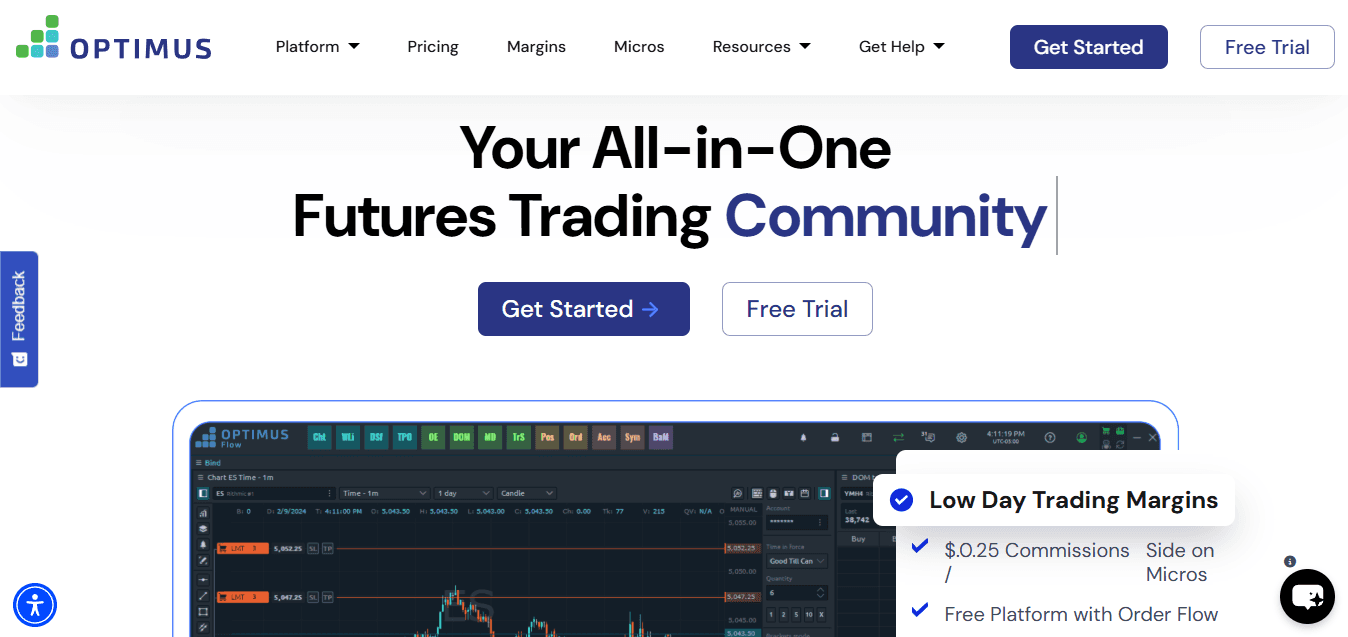
Optimus Futures focuses on flexibility and cost efficiency for active micro futures participants, directly addressing high commission costs and rigid platform limitations that amplify risks for smaller accounts. The broker prioritizes trader-centric features for seamless daily operations.
Key Features:
- Highly competitive day margins for micros that maximize leverage while maintaining control.
- Support for multiple third-party platforms to match individual trading styles.
- Transparent pass-through pricing that avoids hidden costs on high-volume micro trading.
- Dedicated futures specialists for personalized guidance on active setups.
- Fast funding and withdrawal processes to keep capital working.
- Advanced risk tools and position management, suited to micro-scaling.
- Regular platform updates based on trader feedback for evolving needs.
Commission & Fee Structure: Low per-contract commissions with volume discounts, emphasizing overall cost savings for active micro traders.
Trading Platforms & Tools: Compatibility with NinjaTrader, Sierra Chart, and others, plus proprietary options for versatile execution.
Market Access & Product Range: Full suite of micro E-minis, energies, metals, and additional futures products for diversified active trading.
Minimum Account Requirements & Margin Policies: Low entry barriers with tailored intraday margins optimized for micro futures activity.
Customer Support & Education: Personalized onboarding and ongoing support with resources geared toward futures-specific strategies.
Regulation, Trust & Transparency: Regulated with clear policies and a focus on futures brokerage excellence.
For: Active traders seeking platform choice and personalized low-cost micro futures execution.
Pros: Exceptional flexibility across platforms and a strong focus on cost and margin efficiency.
Cons: May require selection of a compatible platform for optimal experience.
Accessibility: Straightforward account setup for active U.S. traders.
5. AMP Futures

AMP Futures provides dedicated futures infrastructure and aggressive conditions that resolve the issues of platform instability, slow support, and capital inefficiency faced in micro trading. Active traders gain reliable tools and services that support sustained performance.
Key Features:
- Very low intraday margins for micro contracts, preserving capital for more opportunities.
- Multiple high-performance platform integrations for low-latency trading.
- Competitive overall costs focused on active volume traders.
- Strong emphasis on futures education and market insights.
- Reliable order routing during high-volatility periods.
- Flexible account features tailored to day and swing styles.
- Responsive infrastructure for consistent uptime.
Commission & Fee Structure: Discounted rates starting from low per-contract fees with transparent add-ons for micro trading.
Trading Platforms & Tools: Support for leading platforms like NinjaTrader, CQG, and others with advanced charting and execution capabilities.
Market Access & Product Range: Comprehensive access to micro futures across equity indexes, commodities, currencies, and energies.
Minimum Account Requirements & Margin Policies: Minimal requirements with competitive micro-specific margin policies.
Customer Support & Education: Futures-focused support team and educational materials for active trading development.
Regulation, Trust & Transparency: Properly regulated with client-first policies in futures brokerage.
For: Active micro futures traders prioritizing low costs, platform options, and reliable futures specialization.
Pros: Strong value on margins and commissions, broad platform compatibility.
Cons: Support experience may vary during peak times for some users.
Accessibility: Efficient process for U.S.-based active traders with demo capabilities.
How to Choose the Best Micro Futures Broker for Your Trading Style

Choosing the right micro futures broker directly impacts your trading costs, execution quality, risk management, and long-term results. The best choice depends on your trading style, account size, platform preferences, and the markets you trade most frequently.
Commission and Fee Structure
Transparent pricing forms the foundation of profitable micro futures trading because hidden charges quickly erode the advantages of smaller contract sizes. Compare per-contract rates alongside any platform subscriptions, data fees, or activity minimums that affect low- to high-volume traders differently. A seemingly low base rate, paired with monthly software costs, hurts occasional traders, while active ones benefit from volume discounts and all-in transparency, which keep net expenses predictable and aligned with their trade frequency.
Trading Platforms and Tools
Your chosen platform must deliver speed, reliability, and customization that match your decision-making process in micro futures.
- Prioritize real-time interactive charting
- One-click order entry directly from charts
- Mobile compatibility
- Support for advanced indicators or automation
These elements eliminate friction during volatile periods, allowing precise entries and exits that protect small account equity and capitalize on short-term opportunities without technical disruptions.
Market Access and Product Range
Broad access to liquid CME Group products ensures you can diversify beyond a single index and adapt to shifting market conditions. Look for coverage of micro equity indexes:
- Energy
- Metal
- Currencies
- Related contracts
So your strategy can evolve in response to opportunities across different sectors. This range prevents overreliance on a single asset class and supports hedging or risk-spreading, which is essential for sustaining performance across varying volatility regimes.
Data Feeds and Execution Speed
Low-latency data and routing directly influence fill quality and slippage in micro futures, where every tick matters for tight risk parameters. Quality feeds provide accurate depth and volume information while fast execution minimizes the difference between your intended and actual prices. Traders who demand this combination avoid costly delays that compound over dozens of daily trades and maintain an edge in fast-moving sessions.
Customer Support and Education
Responsive assistance and structured learning resources accelerate your progress toward consistent results by resolving issues quickly and deepening your market understanding. Seek brokers offering multiple contact channels during trading hours plus tutorials, webinars, and guides focused on micro futures mechanics, platform navigation, and risk techniques. This combination builds confidence and prevents small problems from escalating into larger setbacks.
Regulation, Trust, and Transparency
Strong oversight from the CFTC and NFA membership protects your funds through segregated accounts and enforced standards that promote fair practices. Verify the broker's regulatory status, clearing relationships, and history of transparent reporting to ensure reliability during volatile periods. This foundation gives peace of mind so you focus on trading rather than worrying about operational risks.
Compare Minimum Requirements and Margin Policies
Review account funding thresholds, especially intraday margin levels, for your target micro contracts, as lower requirements unlock greater flexibility and reduce capital strain. Policies that adjust transparently for volatility while offering portfolio margin options suit active styles. Prop firms provide an alternative path for traders seeking larger effective capital without full personal risk.
Consider Whether a Prop Firm Better Fits Your Goals
Some traders eventually discover that access to capital is a bigger challenge than finding the right broker. In these cases, a proprietary trading firm may provide an alternative path by allowing qualified traders to manage significantly larger accounts without committing substantial personal capital. For futures traders exploring funded trading opportunities, AquaFutures offers evaluation-based and instant-funded account options that provide access to up to $450,000 in simulated funding. Traders who qualify can keep up to 100% of their profits while operating within clearly defined risk parameters.
The firm focuses on futures traders and offers straightforward account structures that help traders scale without relying solely on their own capital. This makes funded trading an option worth considering alongside traditional brokerage accounts for traders seeking greater buying power and growth opportunities.
Why AquaFutures Is an Alternative to the Best Micro Futures Brokers
The broker question matters more than most beginners expect. Choosing where to trade micro futures shapes not just your costs but your psychological experience, your ability to size positions correctly, and ultimately whether your edge survives long enough to compound. The problem is that most traditional brokers are built around capital, not skill.
What the Traditional Model Actually Costs You
The familiar approach is to open a personal account, deposit $5,000 to $10,000, and trade micro contracts while absorbing every loss directly from your balance. That structure works fine during winning streaks. During drawdowns, it quietly rewires your decision-making. Traders tighten stops too early, skip valid setups, or overtrade to recover losses faster. The capital constraint becomes a psychological constraint, and the two are nearly impossible to separate once they fuse.
Intraday Margins and Structural Flaws
According to AquaFutures, intraday margins as low as $50 per contract are available through select brokers, which helps at the entry level, but low margin requirements alone do not change the fundamental reality that every dollar lost comes directly from your account. The failure point is usually not strategy. It is the structure surrounding the strategy. A trader with a positive expectancy system can still blow an account if the position sizing relative to personal capital creates emotional interference on every trade. This is where the traditional brokerage model, regardless of how competitive its commissions are, runs into a structural ceiling for active micro traders.
Why the Your Skill, Our Risk Model Changes the Math
Most traders handle this by simply depositing more personal capital to reduce the psychological weight of individual losses. The hidden cost is that this approach requires significant savings before trading feels manageable, making the barrier to professional-level execution financial rather than skill-based. Funded accounts for futures trading shift that equation by providing up to $450,000 in capital, while the trader bears no direct loss liability on the firm's funds.
AquaFutures takes this further with a 100% profit split on the first $15,000 earned, then 90% thereafter, with weekly payouts and a 24-hour payment guarantee. According to AquaFutures' Top 10 Prop Firms research, funded models can offer up to a 90% profit split to traders, making consistent micro performance far more financially meaningful than the same results inside a modest personal account.
What Separates a Real Alternative From a Marketing Claim
The operational details matter as much as the headline numbers. No time limits on evaluation periods, clear 6% profit targets, platform flexibility across tools like Tradovate and DeepCharts, and 24/7 support backed by a 9.4 out of 10 rating from over 5,000 reviews are not minor features. They are the difference between a structure that supports disciplined trading and one that quietly punishes it. A trader with 225,000 peers in an active community learns faster, resolves platform issues without losing trading sessions, and builds accountability that isolated retail accounts simply cannot replicate.
Evaluating Brokers Beyond Commissions
The criteria for evaluating any micro futures broker should include more than commission rates and contract availability.
- Fast
- Reliable reward payouts
- Transparent rules
- Genuine access to capital
Are non-negotiable for anyone who treats this as a professional pursuit rather than a hobby. When the broker's structure aligns with how skilled traders actually operate, the platform stops being an obstacle and starts being an advantage. What comes next might be the one detail that changes how seriously you take the starting cost.
Related Reading
- Excess Margin
- Performance Bond vs Payment Bond
- Performance Bond Requirements
- Futures Brokers With Low Intraday Margin
- Capital Allocation Strategy
- How To Trade Micro Futures
- How To Calculate Implicit Interest Rate
- Best Micro Futures Broker
Unlock up to 50% off Your First Funded Account for Futures Trading
The question of starting cost matters more than most traders admit. If your broker structure demands personal capital at risk before you've proven your edge at scale, the cost is never just the deposit. It's every hesitation, every early exit, every position you didn't take because the loss would have hurt you personally. Funded accounts for futures trading through AquaFutures remove that friction entirely. You trade up to $450K in simulated capital, keep 100% of your first $15,000 in profits, and receive weekly payouts within 24 hours, with no personal downside on losing trades. Right now, your first funded account is available at up to 50% off, so the entry point is lower than the hesitation cost of staying with a structure that works against your growth.
